
Originally reported November 11, 2026.
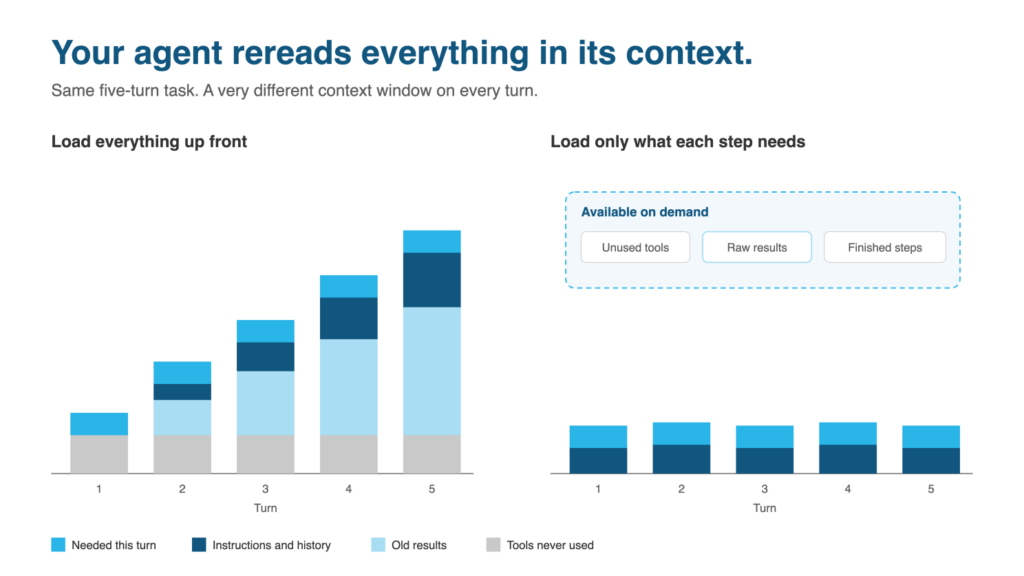
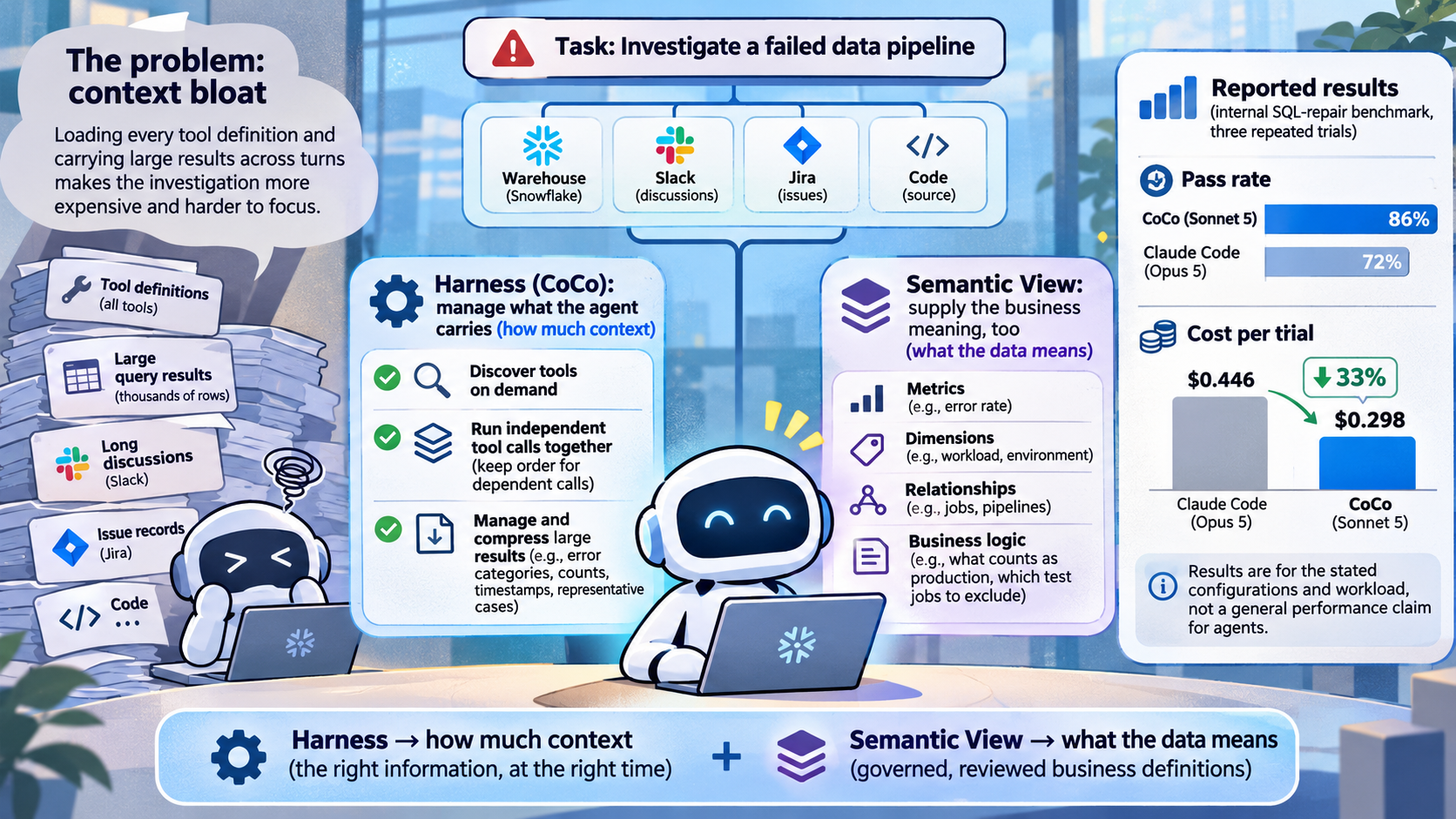
An agent investigating a failed data pipeline may need to query a warehouse, search Slack and Jira, and inspect code. Loading every available tool definition at the start—and carrying large query results through later turns—can make that investigation more expensive and harder to focus. An InfoQ article describes two complementary approaches explored by Snowflake AI Research: managing context in the agent’s runtime, and supplying governed business definitions before the agent has to infer them.
Manage what the agent carries
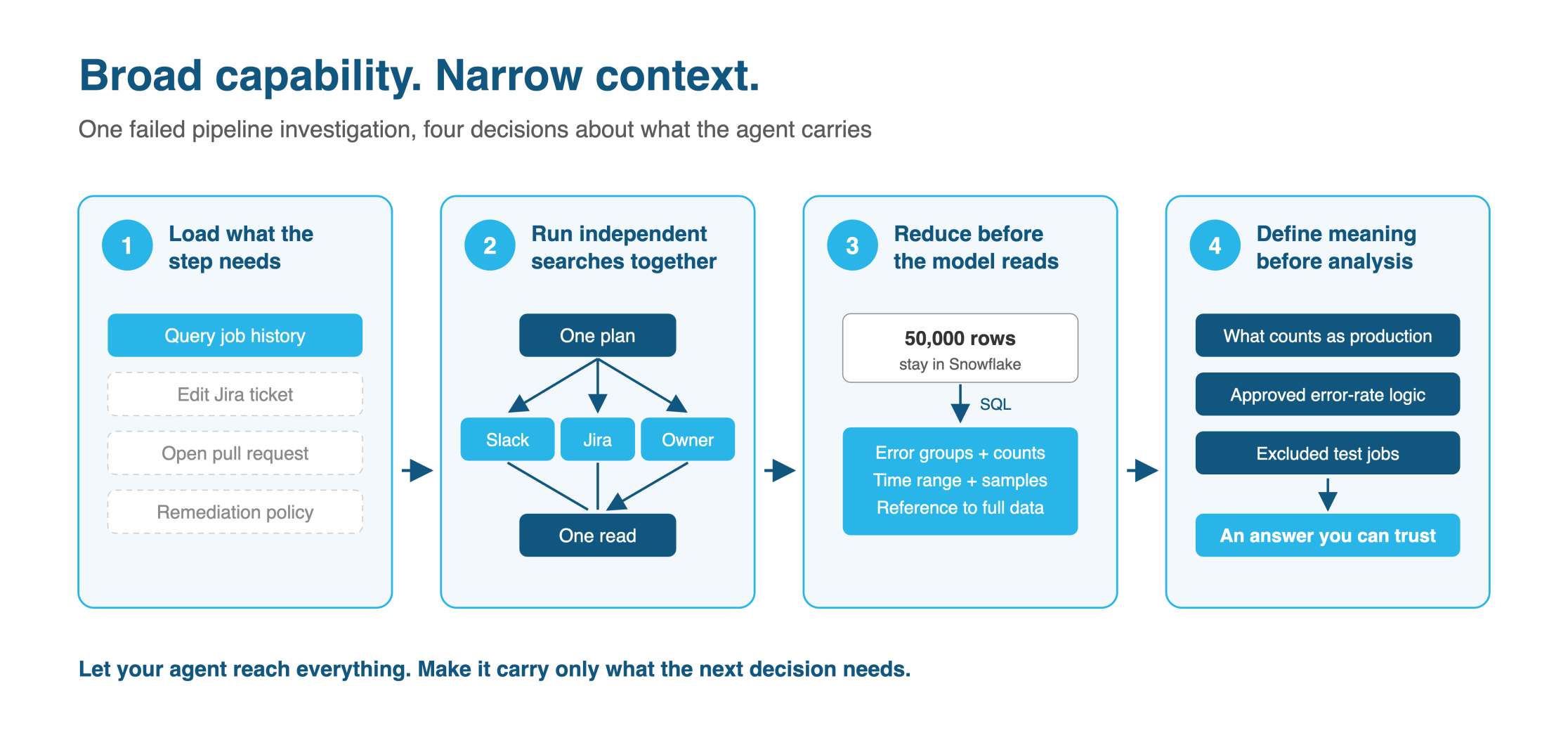
Snowflake’s CoCo harness—the software layer that coordinates models and tools—uses three approaches to limit context growth:
- Discover tools on demand rather than loading every tool definition before work begins.
- Run independent tool calls together when they do not depend on one another’s output, while preserving the order of dependent calls.
- Manage and compress large results instead of repeatedly placing complete raw outputs in the model’s context. For a pipeline investigation, that could mean working first with error categories, counts, timestamps and representative cases, while retaining access to the underlying data when needed.
In Snowflake AI Research’s internal SQL-repair benchmark, the article reports an 86% pass rate across three repeated trials for CoCo using Sonnet 5, compared with 72% for Claude Code using Opus 5. Reported cost per trial fell 33%, from $0.446 to $0.298. These are results for the stated configurations and workload, not a general performance claim for agents.
Supply the business meaning, too
A smaller context does not guarantee a correct answer. An agent might calculate an error rate without knowing which workloads count as production, which test jobs to exclude, or how the organization defines that rate.
The article describes semantic views as reusable definitions of metrics, dimensions, relationships and business logic. Snowflake says Semantic View Autopilot can generate such views from existing data, query history, SQL examples and supported BI assets; teams can then review and refine them in Semantic Studio. That review matters: generated relationships and definitions still need to match the organization’s rules.
A practical starting point is one domain where metric definitions regularly cause confusion. Gather the questions people ask, the SQL used to answer them and the rules behind the metrics; build a semantic view for that domain, then verify its definitions before relying on it. The distinction is straightforward: the harness controls how much context an agent carries, while a reviewed semantic view helps establish what the data means.
Source: infoq.cn (originally published 2026-11-11 19:05 UTC+8)