
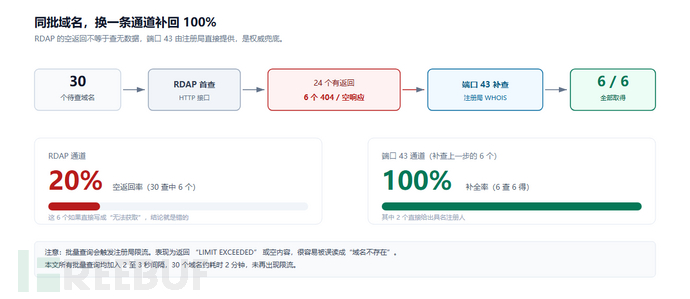
In an account published on November 14, 2026, a security researcher described checking registration records for 30 domains linked to a suspected phishing operation. Six RDAP lookups returned HTTP 404 or an empty response. A subsequent check through port 43 WHOIS returned data for all six, including named registrants for two. The researcher had initially reported that the registrants could not be obtained through public channels—a conclusion those later results showed was premature.
The practical lesson is narrower than “WHOIS is better than RDAP”: an empty response from one lookup path does not establish that a domain has no public registration data.
Why the two paths can disagree
The researcher identified several possible obstacles in an RDAP workflow: some country-code registries lack an RDAP endpoint or do not serve certain second-level domains; HTTP queries can encounter rate limits; and a registry response may contain only limited data, leaving a further registrar lookup necessary. These are explanations for possible failures, not a diagnosis of every empty response in the 30-domain batch.
Port 43 WHOIS offers a separate route. A basic client opens a TCP connection, sends a query followed by a carriage return and line feed, and reads the reply until the server closes the connection. Its response is text rather than structured JSON, so extracting fields requires care: registration dates, for example, can appear under different labels.
For .com and .net, the article describes a two-stage lookup. The Verisign registry response may identify a registrar and a referral WHOIS server without providing registrant details. A client can extract a field such as Registrar WHOIS Server:, whois server: or ReferralServer: whois://..., then query that server. The researcher recommends a maximum referral count so an unexpected chain cannot run indefinitely.
Parsing and rate limits matter
The article highlights three parsing issues with .cn responses: field names may be in Chinese, some responses may need GBK rather than UTF-8 decoding, and a privacy-protection notice must not be mistaken for a person’s name. The researcher’s approach was to retry decoding as GBK when UTF-8 produced replacement characters above a chosen threshold.
An empty WHOIS reply is not necessarily a negative result either. The researcher reported encountering rate limits during bulk Verisign queries, then adding a three-second pause between requests. In that account, the 30-domain run took nearly two minutes without another interruption. The article suggests allowing roughly two to three seconds between bulk queries; that is the author’s operational experience, not a guarantee against rate limiting.
The reported starting points were whois.cnnic.cn for .cn and domains such as .sh.cn; whois.verisign-grs.com for .com and .net; whois.pir.org for .org; whois.nic.io for .io; and whois.nic.biz for .biz. The author also listed whois.arin.net as a starting point for IP-address lookups, with referrals to other regional registries where applicable, and whois.cymru.com for ASN-related queries. These are routing notes from the article, not a promise that any endpoint will disclose a registrant.
For investigations, the researcher recommends retaining more than parsed database fields: save the complete response, the query time in UTC and local time, the server and query string, and a SHA-256 hash of the saved file. That record makes it possible to revisit what the server actually returned if a parser or an interpretation is later challenged.