
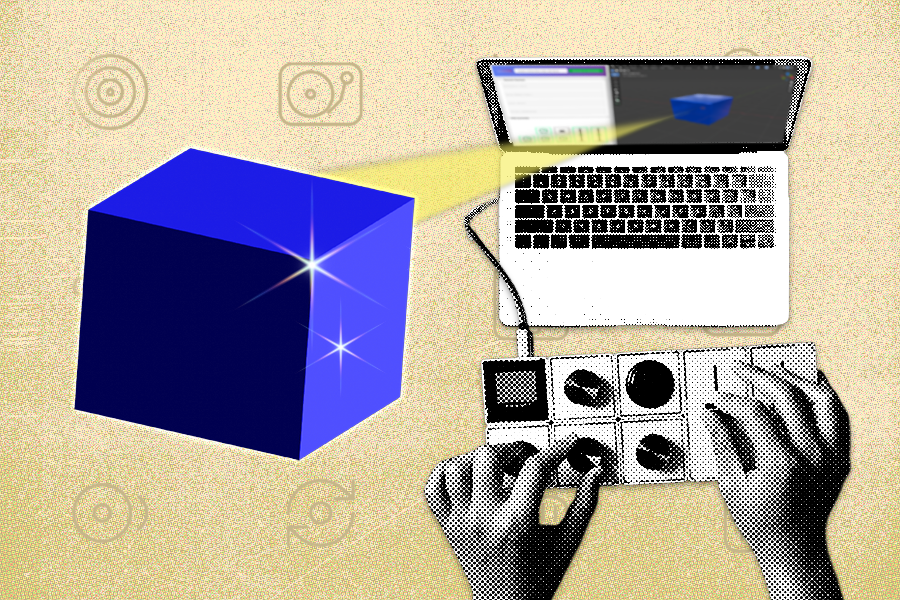
In a report dated November 12, 2026, MIT’s Computer Science and Artificial Intelligence Laboratory (CSAIL) described TangiMap, a research system that assigns new software functions to buttons, knobs and faders on physical devices. Its aim is to let people control creative applications without relying entirely on on-screen widgets.
TangiMap gathers context about the application and the available controls. Depending on the application, its agent can use a software API, an MCP server, or a screenshot interpreted by a vision-language model. It then uses a large language model to organize that information in a file before mapping digital functions to physical inputs.
The researchers demonstrated a standard mixer controlling color adjustments in Adobe Lightroom, with an on-screen display of the assignments. They also mapped mixer controls to sound-mixing software and to features of a model in Blender, including shininess. In Adobe Character Animator, buttons on a control pad triggered character expressions and movements.
These are demonstrations, not evidence yet that the mappings improve performance. CSAIL researcher Yunyi Zhu said she hopes to conduct a user study. The team also wants to simplify setup: it currently creates a custom interface for each application, but hopes to let a designer generate one by photographing a device. Future work would consider ergonomics and where users place their hands during different tasks.
The report identified Zhu and Boston University assistant professor Chang Xiao as the researchers and said they were to present the tool at the ACM Symposium on User Interface Software and Technology in early November. It also said the work was supported in part by Google’s Gemini Academic Program Award.