
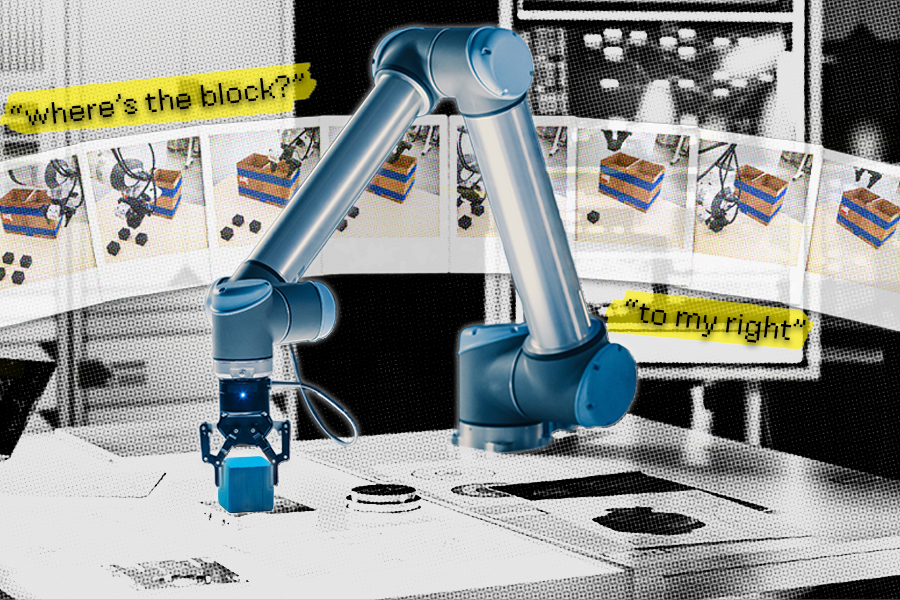
In research reported on November 10, 2026, teams at MIT’s Computer Science and Artificial Intelligence Laboratory (CSAIL) and Carnegie Mellon University described Workspace Models, an approach designed to help robots use past observations without repeatedly consulting a large vision-language model (VLM) while they act.
The implementation separates expensive reasoning from real-time control. During training, one VLM reviews videos and another extracts spatial information from their images. A smaller Workspace Model learns to compress the observations into latent vectors that retain details useful for predicting future actions. It then trains a small policy to predict actions from those vectors. At test time, the Workspace Model and policy run together, allowing a robotic arm to respond to camera and position inputs in milliseconds without running the large VLMs for each decision.
In the researchers’ virtual and real-world robotic-arm tests, the system picked up and put away cubes about 92% of the time—roughly 25 percentage points above the next-best approach, which used an agent to retrieve selected video frames. The researchers also reported that it was the fastest system in their demonstrations among those capable of reasoning over long-term memory. Those results describe the tested tasks, not general reliability across household or factory work.
The design still has a computational limitation: it processes long input sequences, increasing the amount of work as those sequences grow. The team suggests a recurrent approach could reduce that overhead and plans to train with robotics-specific VLMs to improve spatial understanding and task execution. The researchers were scheduled to present the work at the Conference on Robot Learning in November 2026.