
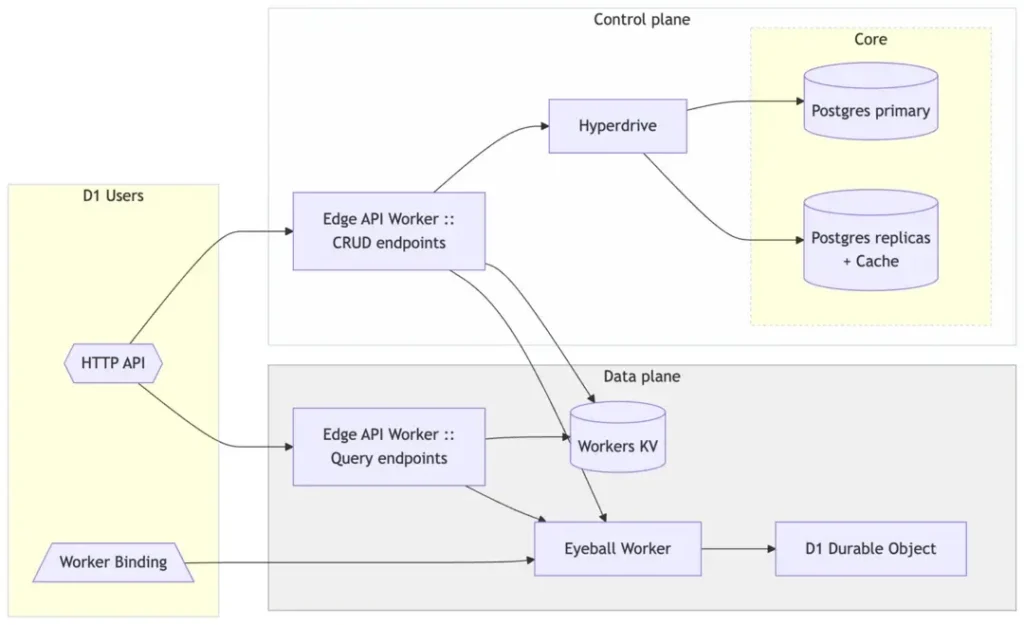
As reported on November 20, 2026, Cloudflare had described a redesign of the control plane for D1, its SQLite-based serverless SQL database. The goal was to manage millions of databases without putting a centralized metadata service on the query path. Cloudflare said D1’s number of daily active databases had grown 18-fold over the preceding year.
The architecture gives three storage systems different jobs: Postgres holds transactional metadata, including whether a database exists and an account’s quota; ClickHouse supports analytics; and Workers KV stores globally replicated routing data. Queries remain separate from centralized management operations.
On the query path, an Edge API Worker handles authentication, authorization, rate limiting and request validation. It forwards requests to an Eyeball Worker, which routes them to the appropriate D1 Durable Object. The Eyeball Worker relies on database-specific authorization encoded in D1 Bindings rather than repeating the permission check. Queries therefore do not have to pass through Postgres.
Cloudflare engineers David Laban and Lambros Petrou explained why routing data lives in Workers KV rather than only in a cache backed by Postgres: if an edge-cached KV entry is evicted, KV can serve the read from its own storage layer. A large cache clear should not cause millions of databases to fetch routing information from Postgres at once—a scenario the engineers said could produce a metastable failure.
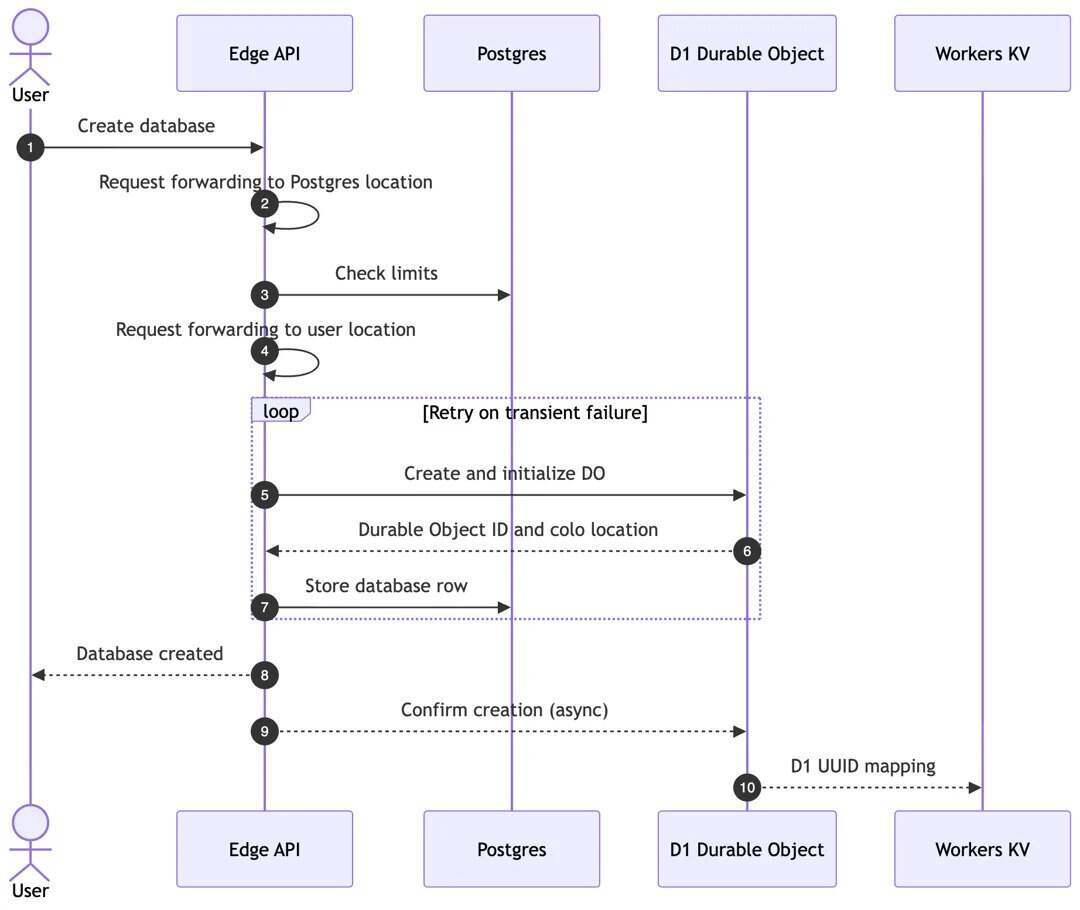
For recovery, each D1 Durable Object checks its state against Postgres roughly every 30 seconds, with a randomized offset to spread the work. This heartbeat can mark an orphaned object as deleted after a failed operation and repair Workers KV routing metadata when a best-effort update fails. Laban and Petrou said the check can tolerate slight staleness, allowing it to use Hyperdrive’s layered caching or Postgres read replicas.
Quota accounting is also asynchronous. Storage-usage updates enter a queue for batch processing, while incremental storage changes maintain pre-aggregated account totals. That avoids repeatedly scanning every database in an account and reduces write contention. Durable Objects check those totals through a short-lived Hyperdrive cache to block writes that could exceed an account’s storage quota.
These are Cloudflare’s architectural explanations, not an independent performance test. In a Reddit discussion cited in the report, user isaackogan argued that D1 also benefits from running close to users on Cloudflare’s global network. The report noted that other Reddit users had raised concerns about D1’s reliability for production workloads; it did not establish whether the redesign resolved those concerns.
At the time of the report, D1’s free tier included 5 GB of total storage, 5 million rows read per day and 100,000 rows written per day. The reported rates beyond that tier were $0.75 per GB of storage per month, $0.001 per million rows read and $1 per million rows written, with no compute or data-transfer charges.