
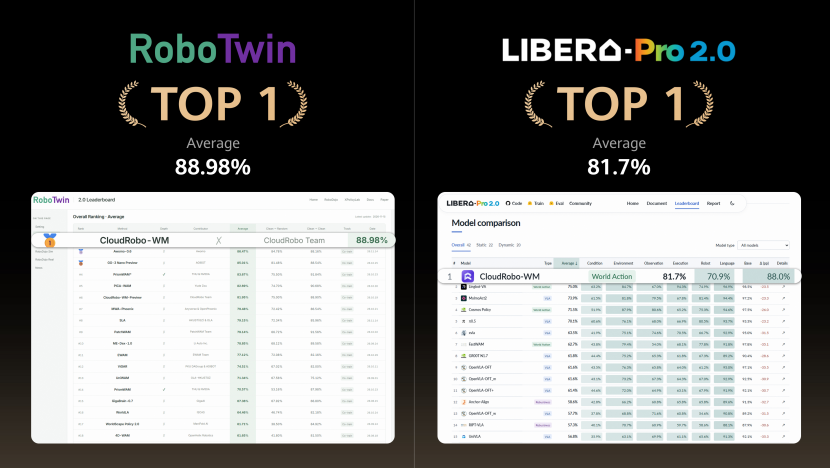
Huawei Cloud announced CloudRobo-WM1.2, an Ascend-native embodied world model, on November 16, 2026. As reported on November 20, the company planned to release the model weights, inference code and post-training code on November 30; the report did not say those materials were already available.
The model uses a shared world-model backbone to represent and predict physical interactions, alongside a DualAct architecture that connects world modeling to robot action generation. Huawei Cloud says CloudRobo-WM1.2 ranked first in the RoboTwin 2.0 and LiberoPro 2.0 evaluations. Those rankings are company-reported claims in the source, not independently verified results presented here.
For developers, the design has several practical distinctions:
- World representation: A Predictive Physical-aware Architecture (PPA) is intended to model physical properties and predict changes after objects interact, rather than rely only on static visual observations.
- Action generation: DualAct can generate actions through the world model, while an action expert based on the MOT architecture offers another route. The action expert’s size can be set for the task during post-training.
- Training data: An adaptive, multi-granularity supervision framework is designed to use incomplete records, including data missing action labels, valid action dimensions, depth information or camera views, instead of discarding an entire record.
- Robot types: Cross-embodiment motion modeling aims to share training across single-arm, dual-arm and wheeled robots while retaining the meaning of each robot’s movements.
- Deployment: Four combinable inference modes—World, Expert Action, Joint and Action-only—are intended to let developers weigh model capability against compute resources and latency.
Huawei Cloud also described Ascend cloud compute, multimodal-data storage and indexing, and AI-framework acceleration as parts of the training and deployment environment. The report does not provide reproducible benchmark configurations, measured inference latency or real-world deployment results. Those details would matter when assessing whether the model’s proposed training and deployment options work for a particular robot.