
Originally reported by InfoQ on November 11, 2026.
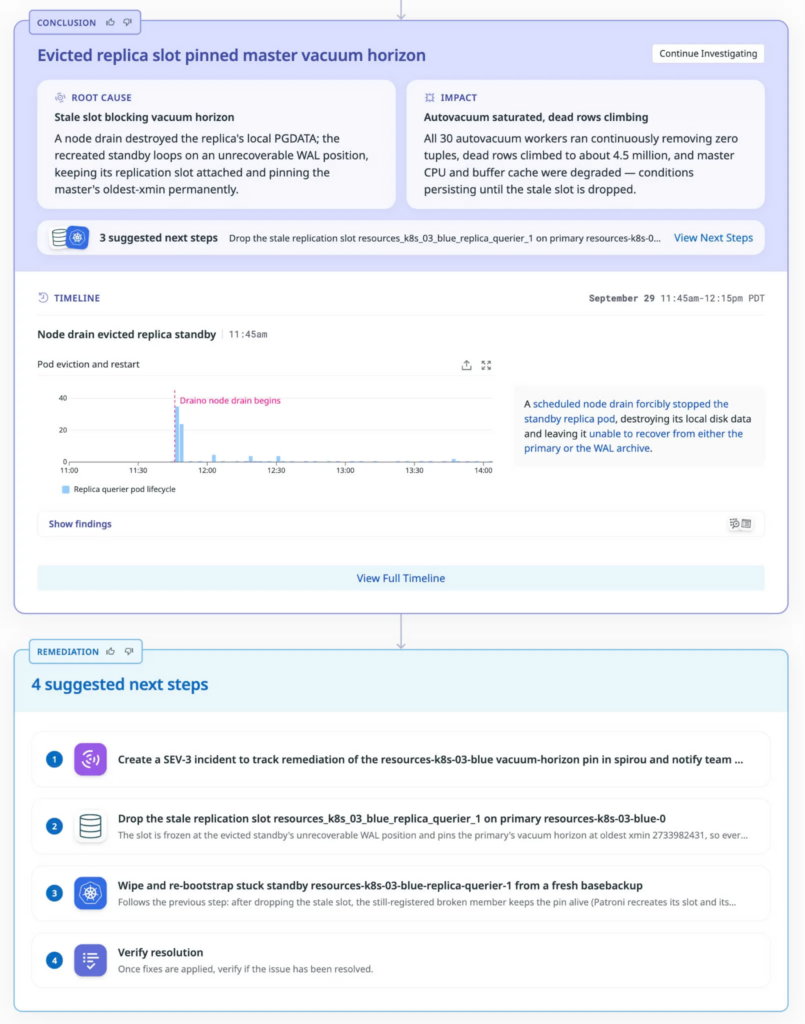
Datadog has introduced Scout, a model for investigating production incidents within Bits Investigation, its AI SRE product. Scout can take an alert, examine telemetry and suggest a likely cause. As of the original report, Datadog engineers and a small number of customers were using a closed preview; the company had not announced a general release date.
The design addresses a practical cost problem: an investigation may require repeated model calls to query data, assess the results and choose what to inspect next. Datadog says using general-purpose models for every alert would be too expensive. Its aim is for Bits to start gathering evidence while an engineer is responding.
What Datadog measured
On Datadog’s AlertEval benchmark, the company reports that Scout at its medium setting scored similarly to GPT-6.1 Sol high and Claude Opus 5.5 high, at an estimated inference cost one-third to one-eighth as high. Datadog also says Scout at xhigh performed comparably to Claude Fable 5.1 xhigh at one-quarter of its cost. It did not publish specific prices; these are relative cost comparisons, not published rates.
AlertEval draws on real alerts, archived telemetry and incident explanations written by Datadog engineers. An LLM judge compares model reports with expert reports, scoring matches on immediate and root causes while penalizing contradictions and unsupported inferences. Datadog cautions that a score from 0 to 100 is not a percentage of incidents successfully resolved.
Datadog also tested Scout on SREGym, a public dataset of 90 failure scenarios. It reports 71 cases solved at medium, 79 at high and 80 at xhigh, compared with 82 for GPT-6.1 Sol xhigh. Datadog conducted all the reported tests, including those of comparison models; the results have not been independently verified in the supplied report.
How Scout was trained—and its current limit
Scout is built on GLM-5.3 Flash. Datadog says it post-trained the model with reinforcement learning on simulated incidents generated from patterns in historical cases, and that the training material contains no customer data. Each simulation includes an alert, queryable telemetry and a known root cause. Training tools mimic Bits workflows across logs, metrics, traces, code, deployments and feature flags.
According to Datadog’s technical report, rewarding only the final answer initially led Scout to stop investigations early and make fewer inferences. The team changed the reward to account for correctness, exploration and supporting evidence. In some training runs, it also removed tools or shortened the available time to discourage a fixed investigation path.
Scout’s preview does not perform repairs. It investigates, offers a diagnosis and suggests recovery steps; engineers remain responsible for final changes. Datadog says it plans to add more failure types to its simulations and ultimately wants Bits to carry out remediation, but that is a future goal, not a current capability.
The evidence trail remains an open question for users assessing such tools. After Scout’s announcement, independent AI news account AGTP noted that AlertEval lacked independent testing and asked for an audit trail showing which evidence Scout considered and discarded. Datadog’s reported benchmark results therefore describe its own evaluations, rather than a third-party assessment of how reliably engineers can inspect Scout’s reasoning.