
Originally reported November 12, 2026.
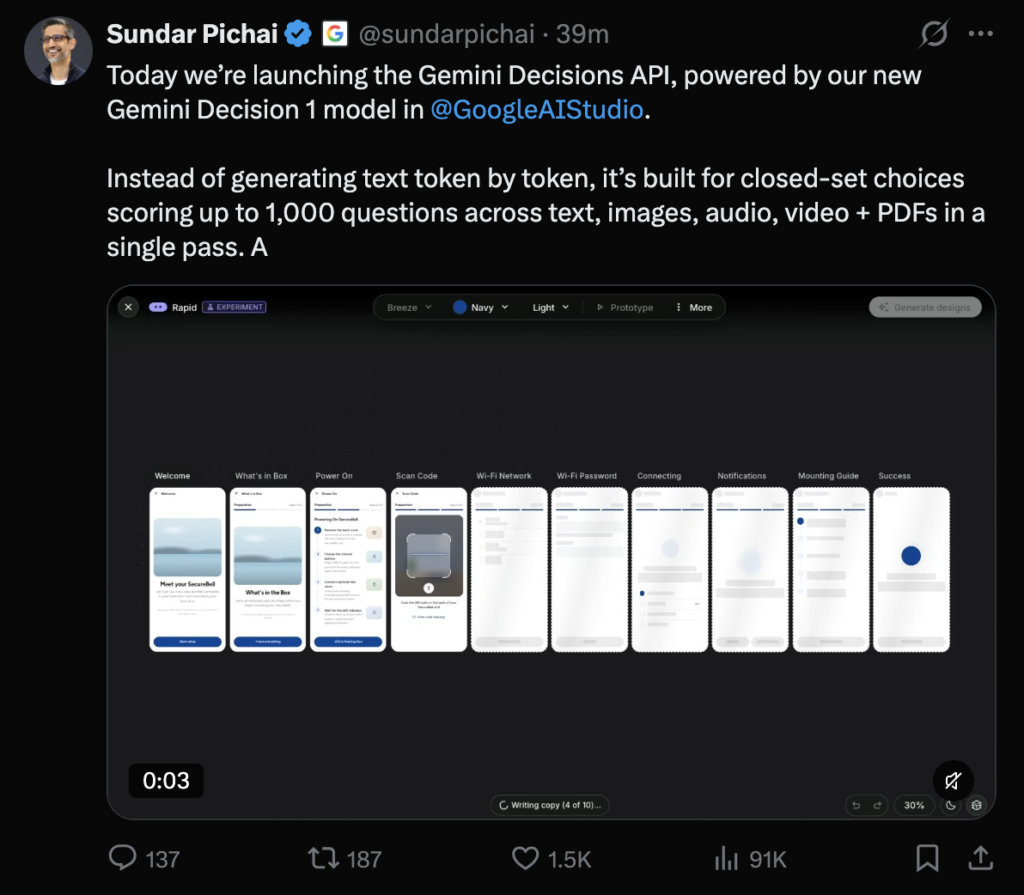
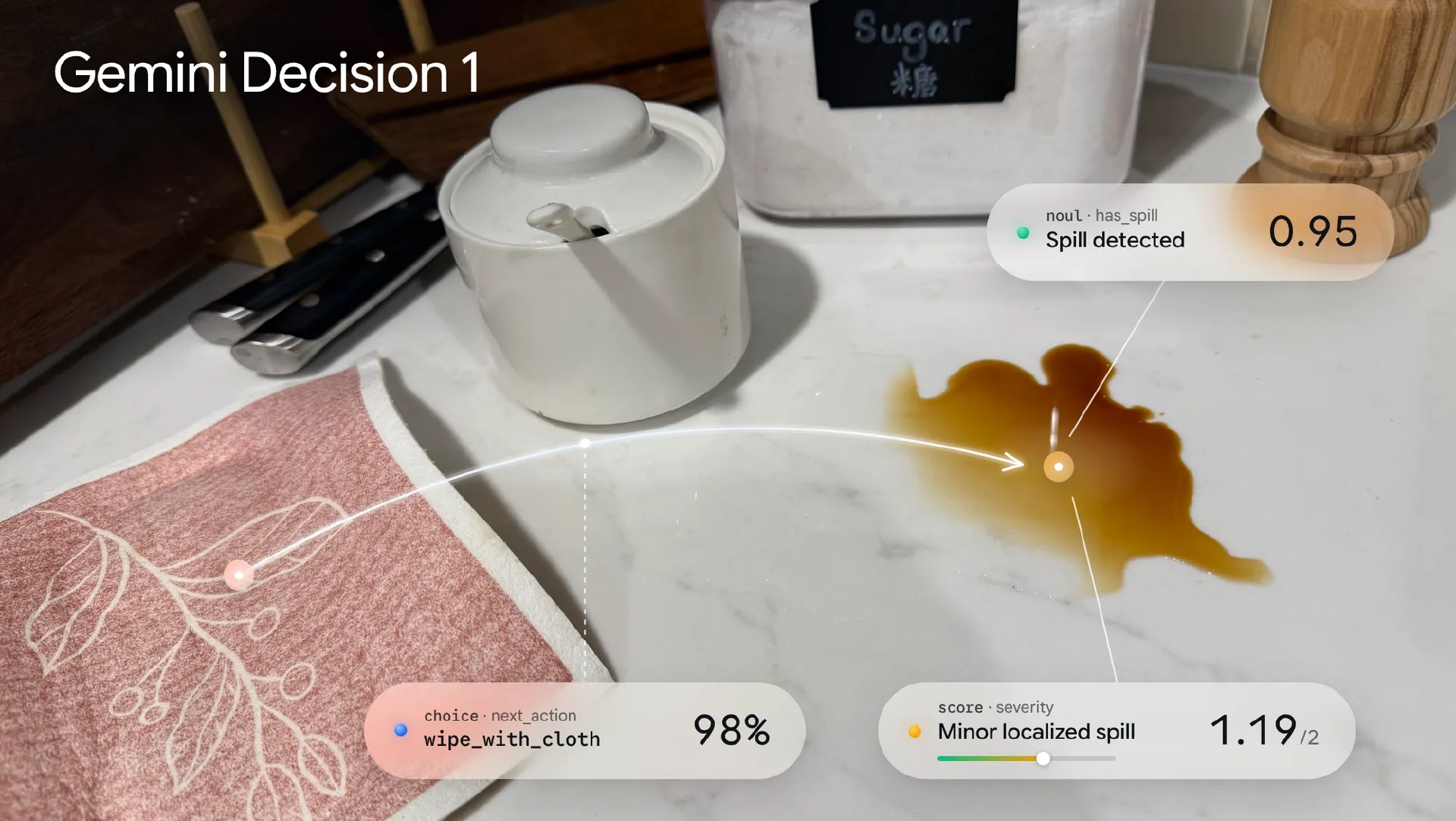
Google has introduced Gemini Decision 1 and the Gemini Decisions API in Google AI Studio. The model is designed for tasks with predefined choices: rather than generating an answer token by token, it scores candidates in a single forward pass. That makes it relevant to workflows such as classification, model routing and tool selection, where an application needs a decision rather than prose.
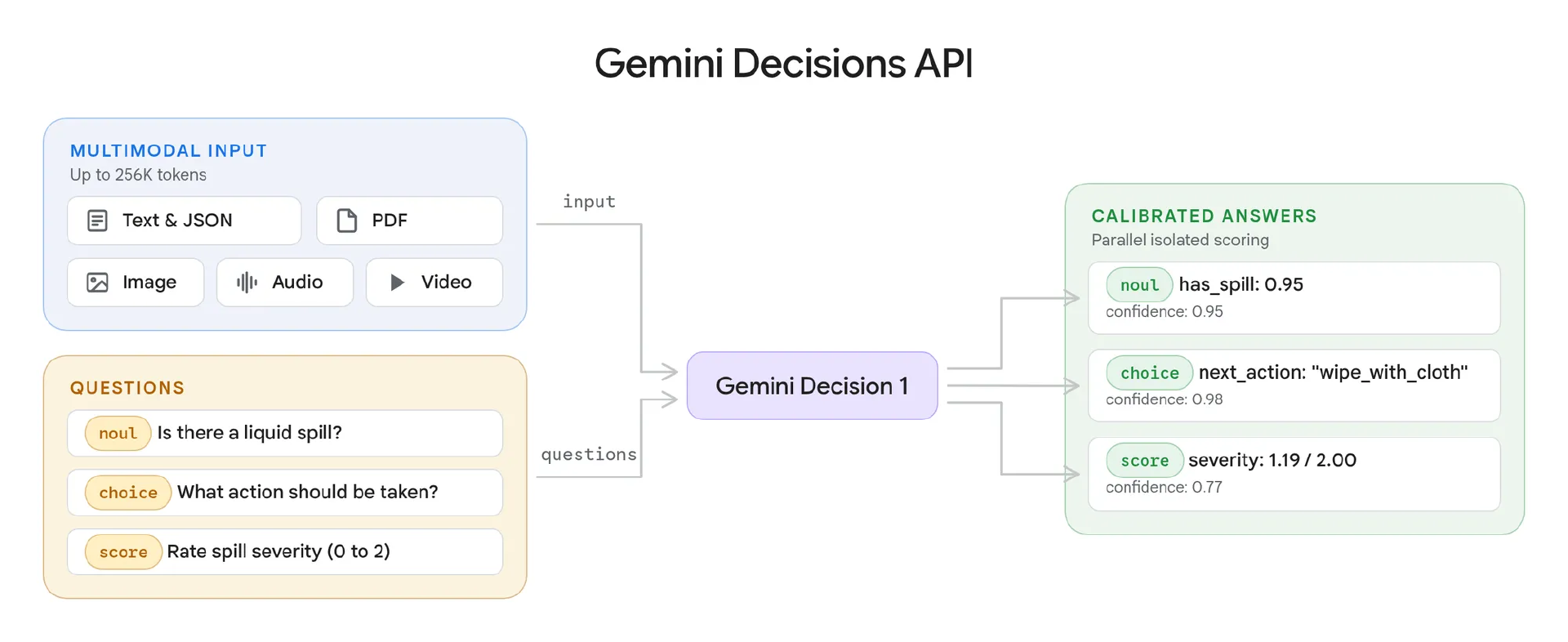
The API supports three decision types: yes/no judgments, multiple choice with 2 to 255 options, and scoring against an ordered rubric. Developers can mix these types in one request and submit up to 1,000 questions. Google says the model accepts text, images, audio, video and PDFs, with a maximum multimodal context of 256K tokens. Responses include probabilities; each decision also carries a confidence value from 0 to 1, which an application could use to route uncertain cases for further review.
Google lists a price of $0.10 per million input tokens, with no output-token charge. In its reported tests using contexts of no more than 16K tokens, median model-compute latency was 50–100 milliseconds and end-to-end latency was about 150–250 milliseconds. Google says latency stayed broadly steady as the number of questions in a request rose from one to 100. These figures describe Google’s tests, not a guarantee for every workload.
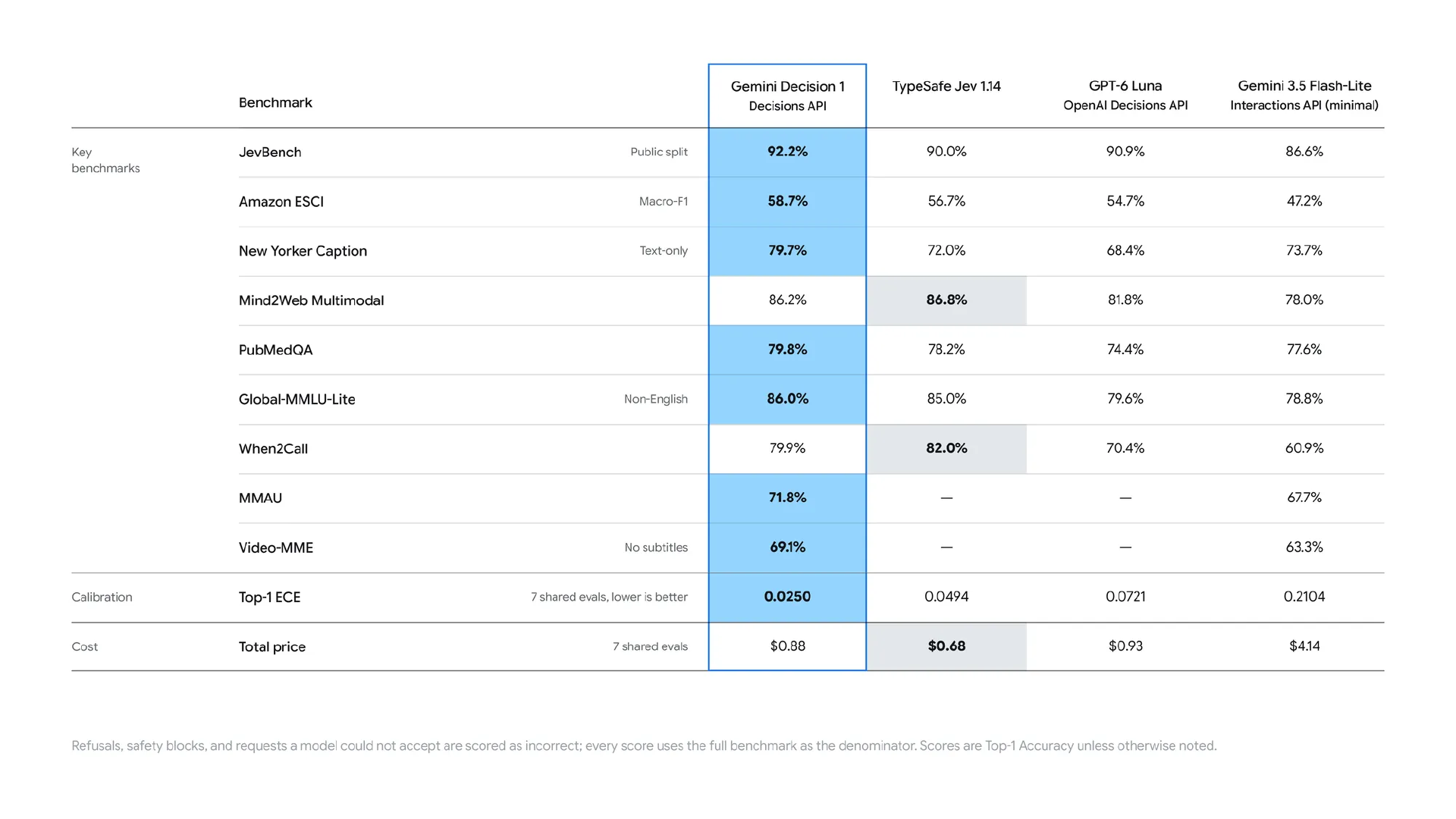
In Google’s published comparison, Gemini Decision 1 ranked first on seven of nine benchmarks. It scored 92.2% accuracy on JevBench, versus 90.9% for GPT-6 Luna, 90.0% for TypeSafe Jev 1.14 and 86.6% for Gemini 3.5 Flash-Lite. It did not lead every test: TypeSafe Jev 1.14 scored 86.8% against Gemini Decision 1’s 86.2% on Mind2Web Multimodal, and 82.0% against 79.9% on When2Call, a tool-calling judgment test. Google also reported a top-1 expected calibration error of 0.0250 for Gemini Decision 1, compared with 0.0721 for GPT-6 Luna, 0.0494 for TypeSafe Jev 1.14 and 0.2104 for Flash-Lite. On Google’s common benchmark set, it said API costs were nearly five times lower than calling Flash-Lite through the Interactions API.
Google says it is using the API to route requests in Gemini Notebook by complexity and reports up to 40% lower latency for everyday queries. Other disclosed uses include decisions in Stitch’s experimental Rapid Canvas workflow, emoji selection in Google Labs’ CC product, and an MCP-tool safety layer within Google Search. For developers, the implementation choice is whether a task can be expressed as explicit options and whether the returned probabilities are reliable enough for its review thresholds; Google’s benchmark and internal-use claims do not establish performance on a particular application’s data.