
In a November 16, 2026 interview with The Pragmatic Engineer host Gergely Orosz, Microsoft CEO Satya Nadella described how advances in AI coding models are changing both developer tools and engineering work. The discussion followed Microsoft’s October 26 announcement of a voluntary departure plan. Orosz asked whether the plan might precede further layoffs as AI improves productivity; Nadella did not make that prediction.
Why the IDE is no longer the only starting point
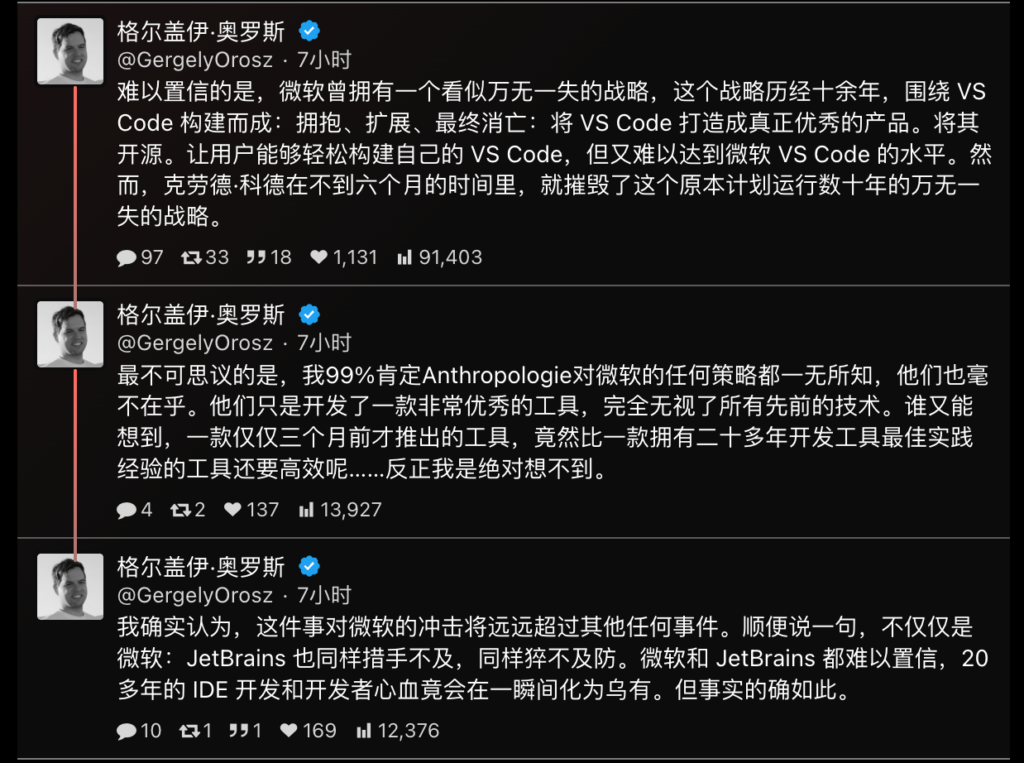
Microsoft entered AI-assisted coding early with GitHub Copilot, while VS Code remained central to many developers’ workflows. Orosz argued that Claude Code’s rise in 2025 changed the competitive landscape: in his experience, some developers began spending less time in an IDE within roughly six months.
Nadella said Anthropic’s advances in model capability made a command-line interface viable for handing an AI system a more complete programming task, rather than asking it only to complete code inside an editor. He acknowledged the shift caught Microsoft’s attention, but cautioned against treating it as the permanent end of the IDE. Different model capabilities may call for different interfaces, he said, and future decision-oriented models could renew the IDE’s role.
What Nadella means by a “software factory”
Nadella described a workflow in which engineers specify intent and requirements, assign bounded tasks to agents, and verify the results. As code generation becomes cheaper, he argued, verification becomes harder and more important. A failure should lead to a test that actually detects the problem; production logs and traces can help identify faults, check fixes and feed what was learned back into development.
He emphasized that this is still software engineering, not a license to generate code without review. Existing products also cannot simply be rebuilt from scratch. For systems such as Windows, he pointed to the difficulty of adapting established build systems and CI/CD pipelines while improving reliability incrementally.
Control, evaluation and agent permissions
For companies building AI systems, Nadella recommended keeping the model, context, memory and agent harness separable. His proposed test for avoiding lock-in: can a team replace a model while continuing to improve on evaluations that measure its own business tasks? That is an architectural recommendation, not a guarantee that swapping models will be easy.
He also urged teams to separate an agent’s intelligence from its authority to act. In his view, more capable models are not necessarily more reliable. He called for runtime monitoring, observability, audit logs and safeguards that treat agents with operational permissions as a potential internal risk.
Nadella said Microsoft intends to keep using OpenAI models while developing its own MAI model family. He also described a possible hybrid workflow in which different sub-agents use local or cloud models according to the task, rather than binding every step to one model family.
What the exit plan does—and does not—say
Asked about Microsoft’s voluntary departure plan, Nadella said future opportunities, team sizes, workflows and roles will differ. He framed the plan as giving employees more choice, including the possibility of seeking other roles within Microsoft. He did not promise that every part of the company would change at the same pace, or that work would remain as it was.
On slower hiring of early-career engineers, Nadella said it was too soon to treat a short-term slowdown as a lasting trend. Companies first need to reorganize teams and establish new ways of working, he argued, before they can judge what skills and hires they need. Orosz’s expectation of further restructuring at Microsoft and elsewhere was his own assessment, not an announced Microsoft plan.
For engineers, Nadella’s advice was practical: spend less time following AI headlines and more time learning the tools firsthand with teams using them on real work.