
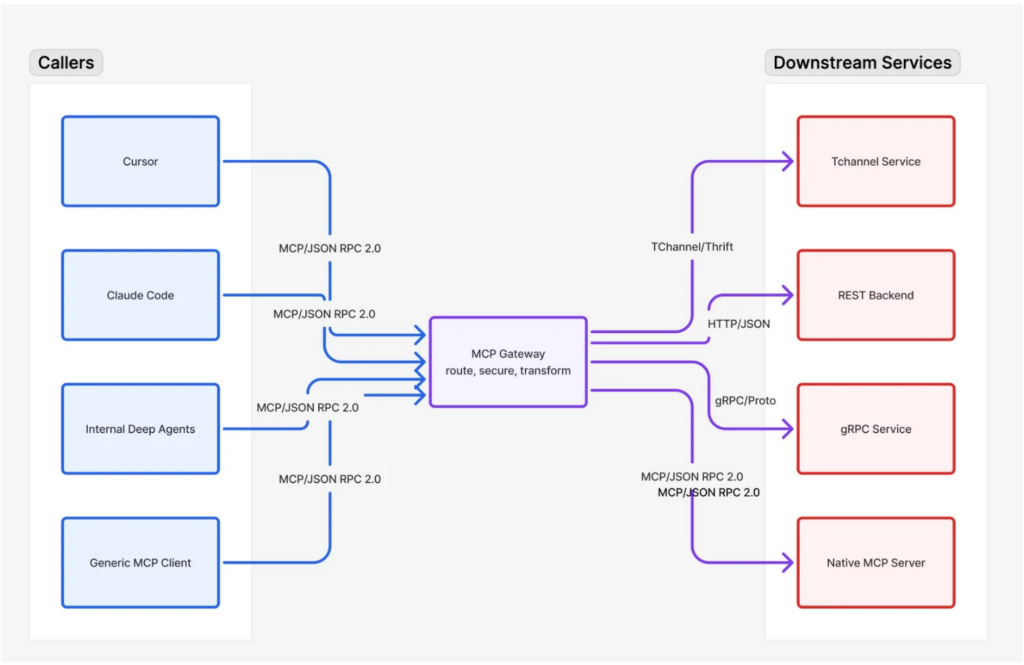
In a report published on November 18, 2026, Uber described an MCP Gateway built to give its internal AI agents a consistent way to discover and call services. The platform supports more than 800 MCP servers and 5,000 tools. Its aim is to reduce fragmented integrations, duplicated infrastructure and inconsistent security practices as agent use expands inside the company.
Uber engineers describe the design as a way to expose existing APIs as MCP tools without changing the underlying services. It separates a MCP Registry control plane from a Proxy Gateway execution layer. The registry holds tool definitions, schemas, ownership and enablement settings. At runtime, the proxy translates MCP requests into HTTP, gRPC or TChannel calls, then converts the responses into MCP-compatible results.
Tool onboarding is partly automated. Uber’s AutoCrawler uses Cadence to scan internal interface-definition registries, extracts API definitions from Protocol Buffers and Thrift schemas, generates MCP-compatible schemas and uses a large language model to write tool descriptions. Newly discovered tools remain disabled by default until their owning teams review and explicitly enable them. Configuration changes can reach the data plane without a service restart or redeployment.
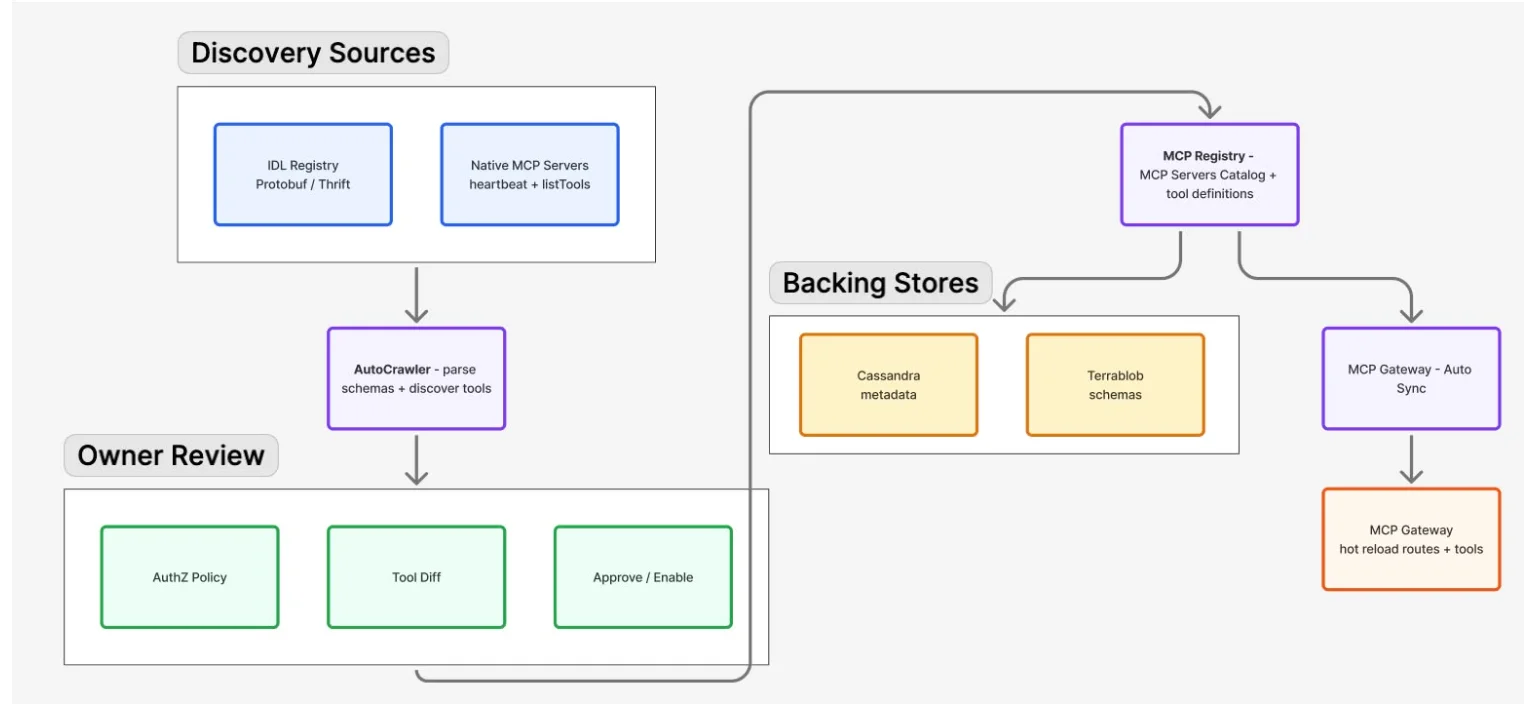
The gateway applies Uber’s internal access controls at both server and tool level. It also supports redacting personally identifiable information and other sensitive data from tool responses. For integrations including Jira and Google, a separate service exchanges internal user tokens for the relevant third-party authentication tokens.
Uber also addresses a practical limit of a large tool catalog: loading thousands of definitions into an agent’s context is inefficient. Omni MCP lets agents progressively search for servers, find relevant tools, retrieve an individual schema and invoke a selected tool on demand. Response Projection lets an agent request only the response fields it needs. Uber’s aifx command-line interface supports tool discovery and invocation by coding agents and can write results to files for selective inspection.
The architecture drew comparisons with established API gateway patterns. In LinkedIn posts cited by the report, Microsoft CoreAI principal software engineer Ajay Sharma and Pipe17 president Kelly Goetsch both likened it to earlier gateway approaches; Tamir Dresher emphasized that familiar distributed-systems concerns—including security, discovery, observability and governance—still apply.