
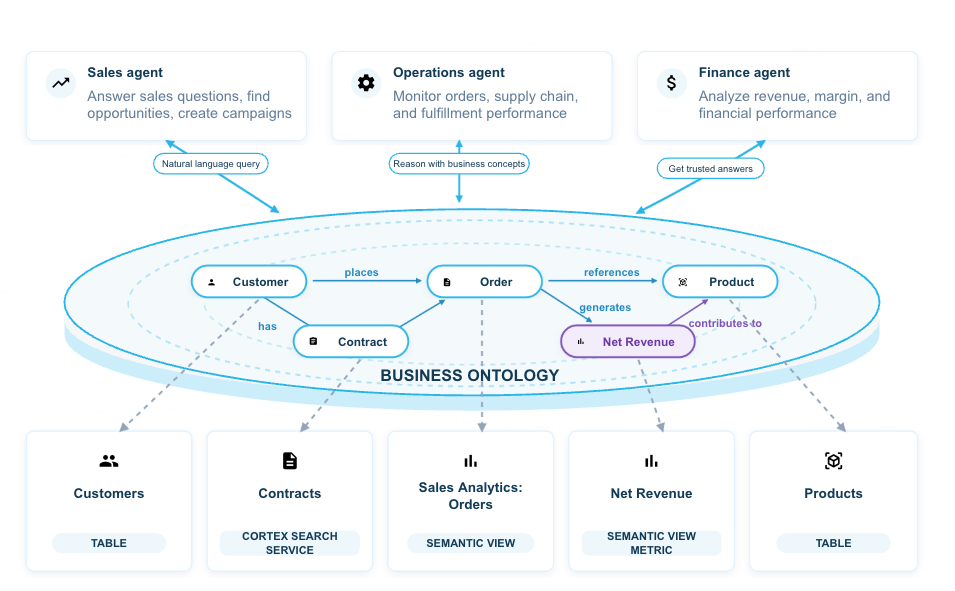
In an account published on November 18, 2026, Snowflake said it had announced Business Ontology on November 3 and that the feature was coming to public preview. The proposed governance layer would let teams define, assign owners to and approve shared business terms, then link those terms to the data and models that implement them. Snowflake positions it as a way for people and AI agents to use the same approved meanings when analyzing enterprise data.
The distinction matters when an agent answers a question about revenue: it needs to know which definition applies, how revenue relates to orders and customers, and where the calculation comes from. Snowflake says that knowledge is often scattered across BI models, dbt projects and employees’ experience.
Three layers with different jobs
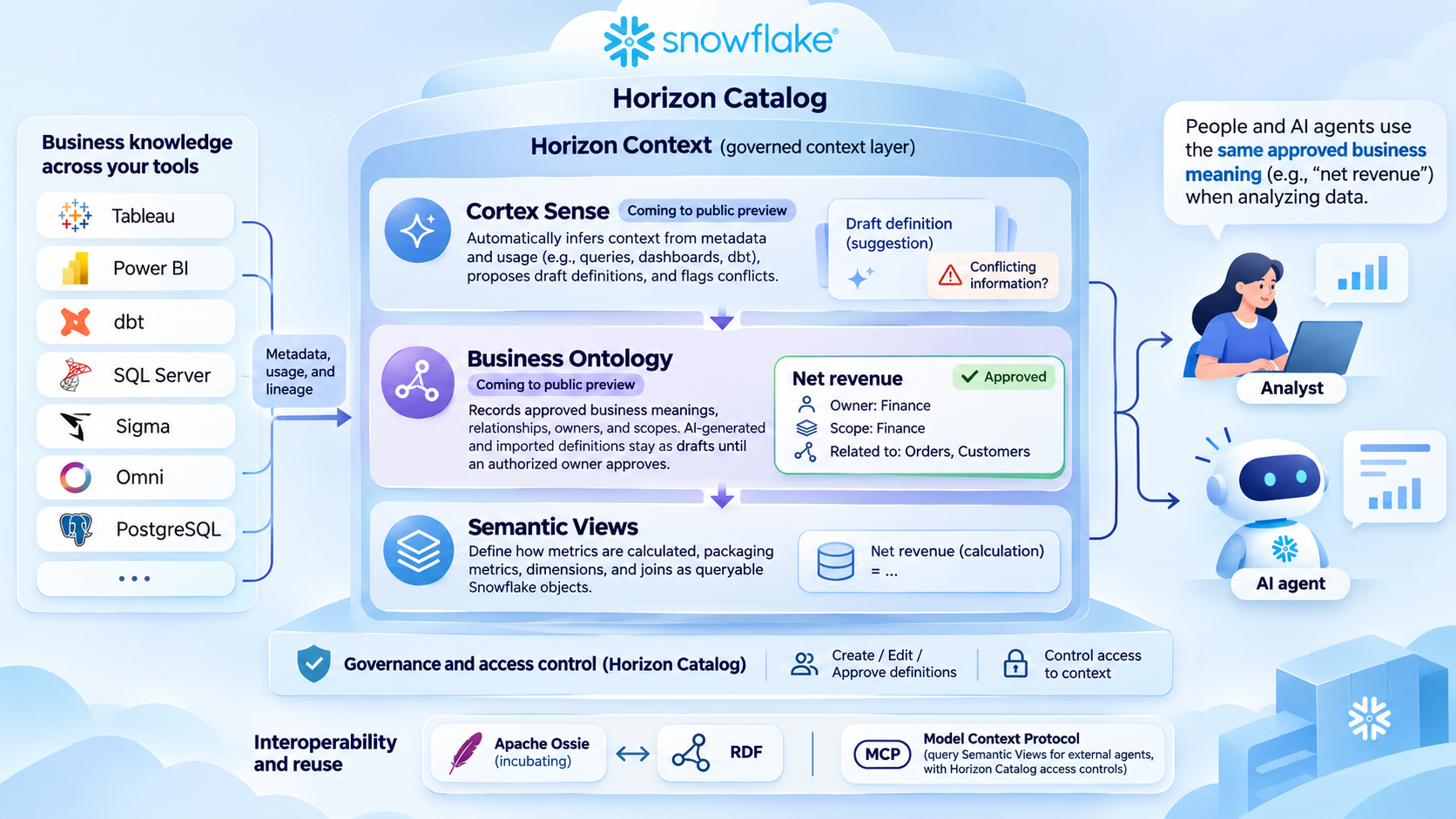
Snowflake describes Business Ontology as part of Horizon Context, a governed context layer in Horizon Catalog. Its approach separates three tasks:
- Cortex Sense, also described as coming to public preview, infers context from metadata and usage patterns such as query history, dashboards and dbt models. Snowflake says it can propose draft definitions and flag conflicting information for review.
- Business Ontology records approved meanings, relationships, owners and scopes. AI-generated suggestions and imported definitions remain drafts until an authorized owner approves them.
- Semantic Views define how metrics are calculated, packaging metrics, dimensions and joins as queryable Snowflake objects. Linking a business definition to a Semantic View does not change that view’s calculation logic.
Snowflake says teams need not adopt these layers in a fixed order. A team could start with a glossary or with executable metrics, then add the other capabilities.
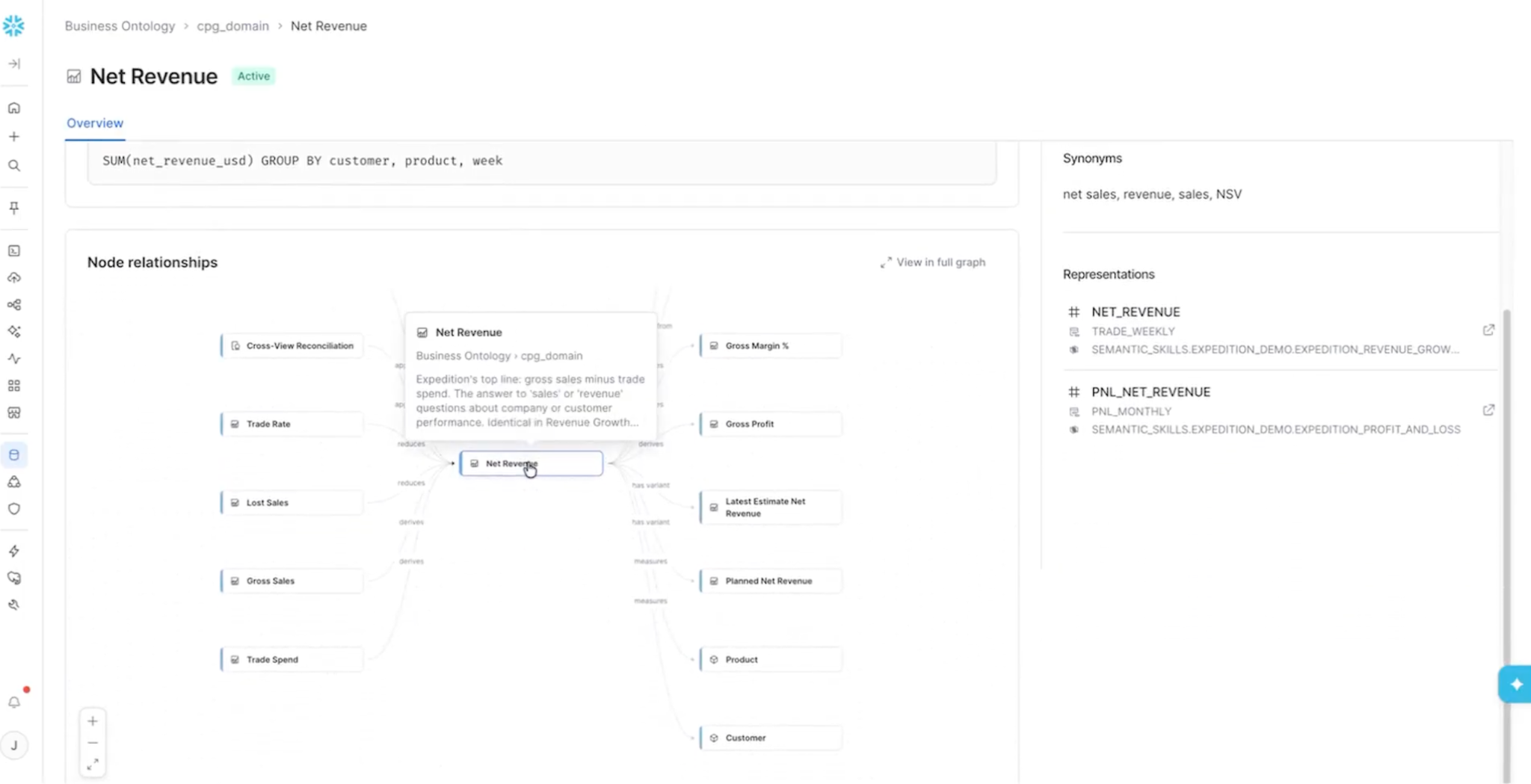
Consider net revenue. An analyst could approve a definition scoped to finance and link it to the metrics that calculate net revenue in Semantic Views. Equivalent metrics in different views could share that definition without forcing the teams to use identical calculation implementations. Conversely, a business could retain separately approved, scoped definitions—for example, different brands’ definitions of same-store sales.
This workflow depends on human review: Snowflake says approved definitions take precedence over Cortex Sense’s inferences when they conflict. Horizon Catalog controls who may create, edit and approve definitions, as well as access to the resulting context.
Reuse across tools
Snowflake says Horizon Context can gather metadata from tools including Tableau, Power BI, dbt, SQL Server, Sigma, Omni and PostgreSQL. It also describes importing and exporting business concepts through formats including RDF and the incubating Apache Ossie project. Semantic Views can import and export Ossie definitions; agents outside Snowflake can query Semantic Views through the Model Context Protocol, subject to Horizon Catalog access controls.
These are Snowflake’s descriptions of its architecture and intended workflow, not evidence that every integration or proposed preview capability has been independently tested. For an implementation team, the central design choice is to keep approved business meaning, metric calculation and automatically inferred context separate—and to make ownership and approval explicit before agents rely on a definition.