
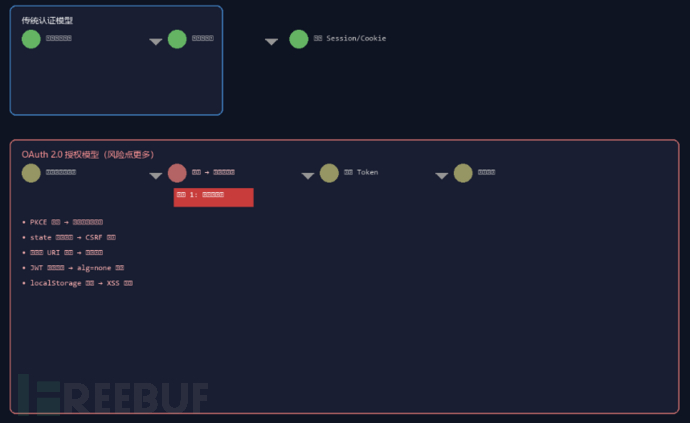
In an article published on November 13, 2026, FreeBuf examined how OAuth 2.0 and OpenID Connect (OIDC) integrations can expose authorization codes or tokens when their safeguards are misconfigured. The practical takeaway for developers is to review the whole flow—from the authorization request to token validation and storage—rather than treating a successful login as proof that the integration is secure.
The article says its testing covered 80 OAuth/OIDC integrations. It reports missing state parameters in 35%, disabled PKCE in 52%, permissive redirect URI rules in 41%, insufficient JWT signature validation in 28%, and token storage in localStorage in 67%. These are the article’s reported findings, not established prevalence rates for OAuth deployments generally; it does not provide enough detail about sampling and test methods to generalize them.
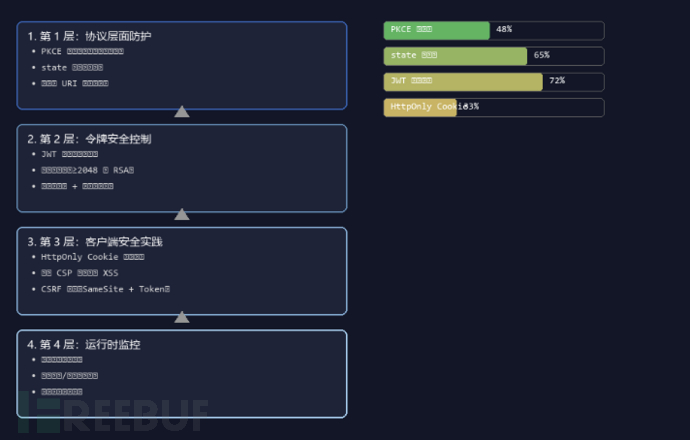
A focused review checklist
- Check PKCE on authorization-code flows. For public clients, generate a fresh
code_verifier, send its S256-derivedcode_challengewith the authorization request, and submit the original verifier when exchanging the code. Check that the authorization server enforces the match—not merely that the client sends the fields. - Bind the response to the initiating request. Generate an unpredictable
statevalue, retain it for the pending authorization attempt, and reject a callback if the returned value does not match. A fixed value, or one that is sent but never checked, does not provide that protection. - Review registered redirect URIs. Compare callback URIs against explicit registrations rather than relying on broad wildcard or subdomain rules. Inspect scheme, host and path handling, including any normalization performed before comparison.
- Verify tokens rather than decoding them. If an application relies on a JWT for authentication or authorization, configure its verifier to require a valid signature and an expected algorithm and key. Decoding a token only reads its claims; it does not establish that they are trustworthy. The article also warns against weak signing secrets and acceptance of unsigned tokens.
- Assess token storage alongside XSS and CSRF defenses. A script running in an affected origin can read tokens kept in
localStorage. AnHttpOnlycookie prevents JavaScript from reading that cookie, but it must be set by the server and does not eliminate the need to assess CSRF protection. The article’s client-sidedocument.cookieexample should not be used to implementHttpOnly: JavaScript cannot set that attribute.
The source presents attack scenarios and scanner output as illustrations, as well as additional success-rate figures from its tests. It does not supply enough verification detail to treat those scenarios as independently confirmed incidents or the scanner output as a reproducible tool result. For an implementation review, the actionable starting point is to inspect the actual client configuration, authorization-server settings, callback validation, token verifier and storage path, then test those controls in an authorized environment.