
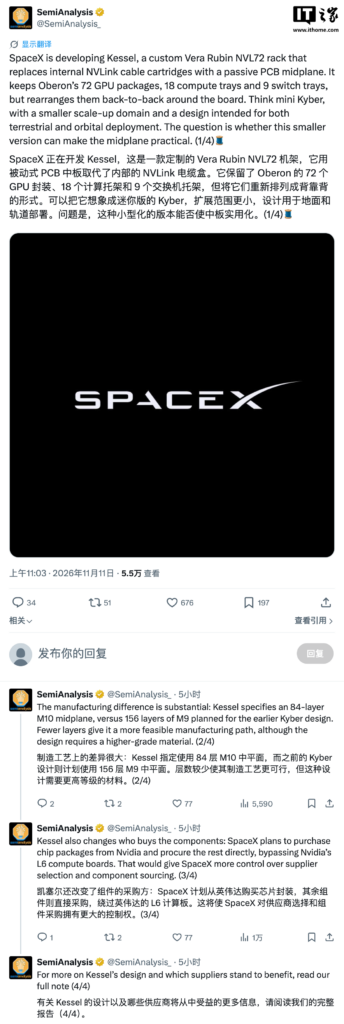
In a report published on November 11, 2026, semiconductor research firm SemiAnalysis said SpaceX was developing a custom AI server rack called Kessel. The proposed design would retain Nvidia GPU packages while giving SpaceX more control over the components around them. SemiAnalysis said Kessel was intended for both ground-based data centers and orbital computing; the report did not establish that the rack had been deployed in either setting.
The procurement change is central to the design. According to SemiAnalysis, SpaceX plans to buy chip packages directly from Nvidia and source other components itself, rather than purchase Nvidia’s L6 compute boards. That would give SpaceX more choice over suppliers, but it would not remove Nvidia chips from the rack.
Kessel would also change how the rack is connected internally. Instead of the internal copper-cable modules used to link compute equipment and switches in Nvidia’s standard Vera Rubin NVL72 rack, the proposed design uses a passive circuit-board midplane at the center of the rack. Its 18 compute trays and nine switch trays would mount back-to-back on either side. SemiAnalysis said the design retains the Oberon configuration’s 72 GPU packages.
SemiAnalysis compared Kessel with Nvidia’s larger Kyber design, which it had described in March 2026 as having 144 GPUs. The firm called Kessel a smaller version of Kyber. It said Kessel’s proposed midplane uses M10 material and 84 circuit-board layers, versus M9 material and 156 layers in the earlier Kyber plan. Fewer layers may make fabrication easier, SemiAnalysis said, but require a higher-grade material. Whether the smaller midplane can be manufactured and put into practical use remains uncertain.
The rack plans sit alongside a much larger capacity ambition. SemiAnalysis said in the week before its November 11 report that SpaceX had raised its 2027 compute-capacity target to approximately 13 GW, with projects totaling 3.6 GW under construction across multiple locations. Its analysts said they had identified more than 9 GW of potential capacity. The firm also pointed to expansion around Colossus and a planned data center in part of the Starbase rocket complex. Available power, however, remained a constraint: SemiAnalysis said the electricity supply it had identified was insufficient for those data centers.