
As of November 19, 2026, Red Hat’s enterprise AI work spanned a problem beyond choosing a model: how to change models and hardware without rebuilding production systems, while keeping inference costs and automated actions under control.
Red Hat Greater China president Victor Tsao described the difficulty of adopting a new model after an enterprise has already connected its applications, GPU resources and inference services to another one. Red Hat says its platform supports more than 20 open-source models across more than 700 versions, as well as accelerators from NVIDIA, Intel, AMD and Chinese GPU vendor MetaX. That breadth is intended to give customers more choices; it does not, by itself, make a model change effortless.
From GPU capacity to the cost of a completed task
Red Hat Greater China solutions architecture head Aella Wang described a progression from centrally managed GPUs to shared inference services that produce tokens, and then to model services offered by IT teams to business units. Tsao noted that even as the price per token falls, an enterprise’s total bill may rise when reasoning models and agents use repeated inference, tool calls and verification.
Running inference in-house is not automatically cheaper. The source notes that it depends on steady demand, GPU utilization, operations staff and ongoing model optimization. For a deployment decision, the relevant comparison is the total cost of completing a useful task—not just the price of one token.
Red Hat is involved in vLLM and the distributed inference project llm-d. The source reports that llm-d 1.0, released October 20, added multitenant resource management, request priorities, high availability, rolling upgrades and session-aware routing intended to reuse cached context across agent requests. In an IBM Research benchmark, a roughly 753-billion-parameter model deployed through llm-d supported up to 3,000 concurrent coding agents and peaked above 6.6 million output tokens per minute. An estimate using the test’s cloud rental prices put its per-token cost at five to ten times less than a comparable commercial API. Those are benchmark results and price assumptions, not a general guarantee for enterprise workloads.
Agents need operational boundaries
Wang argued that building a task-specific agent has become easier than governing one. An agent used in IT operations might run scripts, change server settings or access a production database. The practical question is which tools and data it can reach, which actions need human approval and how its activity is audited. AI-generated code likewise still needs checks before it is merged.
According to the source, Red Hat AI 3.5 adds model safety evaluation, agent development templates, safeguards for tool calls, observability and per-user token accounting. It identifies EvalHub as an evaluation tool and NeMo Guardrails as a way to constrain model and agent behavior. A survey released by Red Hat and CIO Times found that nearly 70% of respondents were advancing agent applications, while fewer than 15% had formal governance frameworks in place. The figures describe that survey’s respondents, not all enterprises.
Finding a vulnerability is not the same as deploying a fix
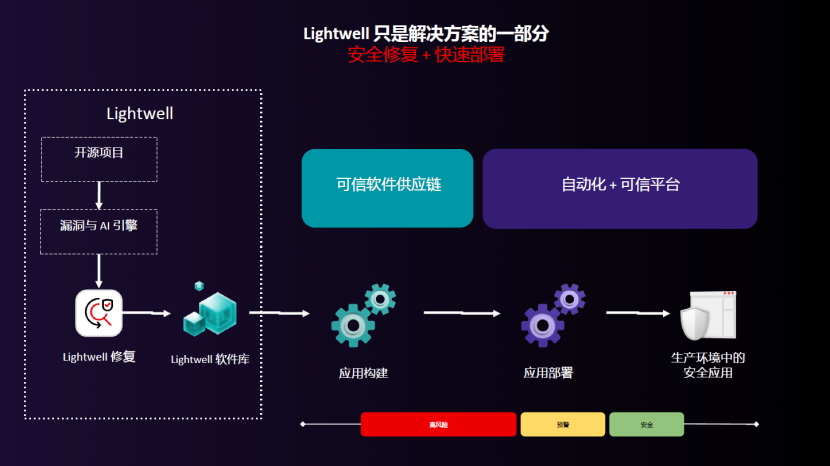
The source also describes Lightwell, an IBM–Red Hat effort to use AI to assist vulnerability identification and engineers to verify fixes and backport patches to software versions enterprises still run. IBM and Red Hat said on October 6 that Lightwell had found and fixed more than 400 previously unknown vulnerabilities in widely used Java libraries, and that Lightwell Clearinghouse had become generally available for organizations seeking review of specific dependencies.
Wang contrasted patch deployment that can take more than 40 days under traditional processes with seven to 14 days using automation. That comparison is her account, not a promised deployment time. Backporting may help organizations avoid a full upgrade when compatibility is a concern, but fixes still have to reach production systems.
Red Hat also described an industrial robotics collaboration with Intel, Zijin Xingyu, Westlake Robotics and Schneider Electric, in which Red Hat supplies the underlying software platform. The proposal extends its platform approach from data centers toward edge devices and centralized management of robots, models and compute resources.
Tsao acknowledged that clear returns on enterprise AI investment remain scarce. Across inference, agents and security, Red Hat’s offerings address concrete operating constraints; whether they deliver measurable returns still depends on how they perform in production.