
Reported November 9, 2026. MIT and New York University researchers have developed FLEX, a learning pipeline that uses natural-language instructions to update a robot’s motion plan. Their study was scheduled for presentation at the Conference on Robot Learning later that month. The reported demonstrations were simulations, not tests of a physical household robot.
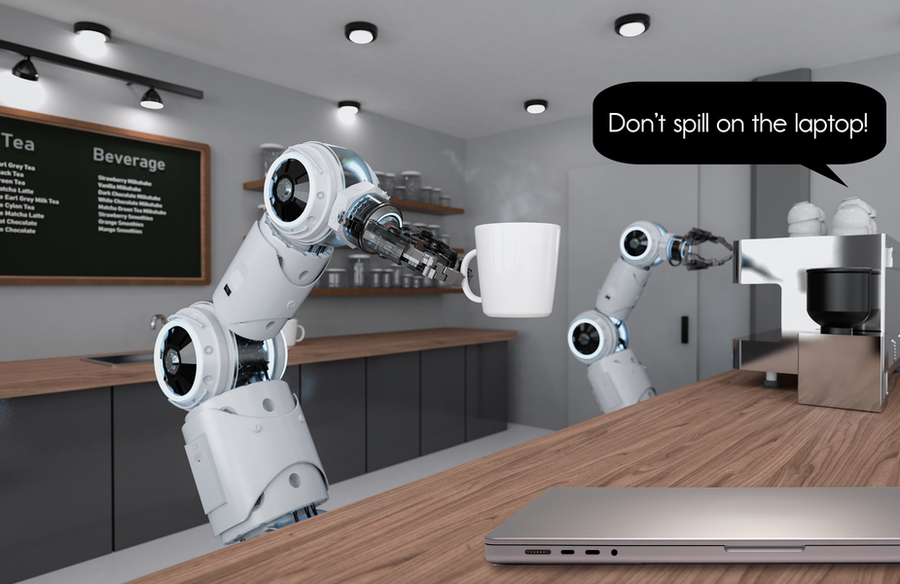
In one scenario, a volunteer typed “Don’t spill on the laptop!” while a simulated robotic arm carried a cup of coffee across a cluttered table. The arm adjusted its path to avoid both the laptop and a nearby phone. The researchers’ aim is for a robot to infer a broader preference—here, keeping liquid away from electronics—without requiring a person to name every object.
FLEX updates the robot’s task-relevant features in three steps:
- Add: Identify an object named in the instruction, such as a mug, as something the robot should avoid.
- Generalize: Use an LLM—GPT-4o in this study—to infer a broader category, such as fragile objects, from the examples the person has provided.
- Mask: Use the robot’s computer-vision system to remove objects from its feature list when they are no longer present.
The researchers say the three-step process takes about five seconds. They tested it in simulated tasks involving a coffee cup, a candle and a bowling ball. In those scenarios, typed corrections led the robot to avoid electronics, flammable objects and fragile items, respectively.
The results show how FLEX handled those simulated interactions; they do not establish how reliably it would infer preferences or plan safe movements in a changing physical home. The study was led by MIT assistant professor Andreea Bobu, with Nathan Dennler of MIT and Audrey Lee and Ilia Sucholutsky of NYU as co-authors.