
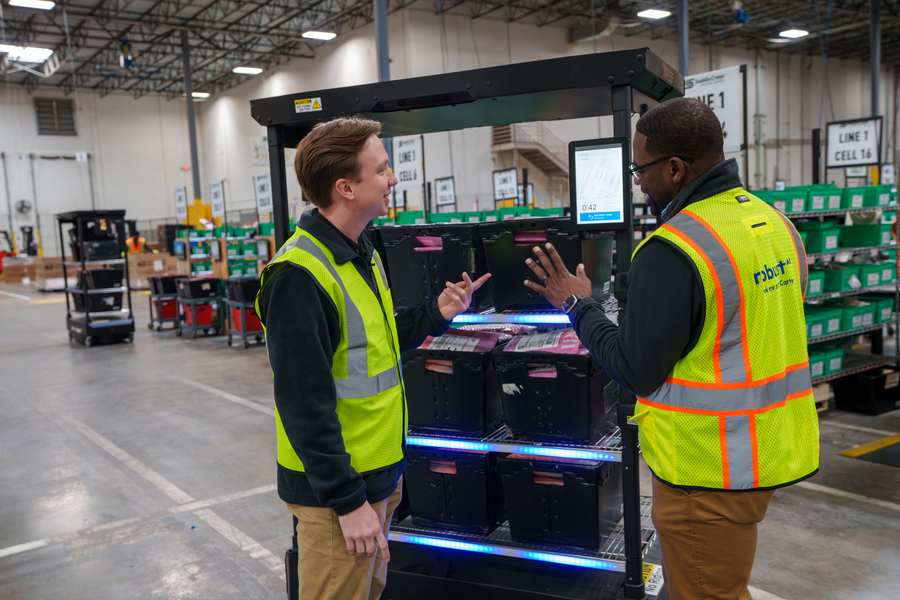
As reported on November 13, 2026, Robust AI’s Carter robots were working in logistics warehouses and factories, helping staff pick and stock shelves and moving items across facilities autonomously. The company’s aim is to fit robots into existing work rather than require a fully automated facility.
Carter resembles a wheeled utility cart. It has a force-sensitive handlebar that lets a person guide it with one hand, an AI-powered vision system, wheels that allow movement in any direction, and controls through gestures or an onboard touchscreen. Workers can also move around it or push it out of the way.
Robust AI describes several ways to put Carter to work. It can guide a worker to items, follow a worker to a loading point, or carry a load to another station after the worker says “done.” Co-founder and chief technology officer Rodney Brooks said customers decide how to integrate the robots into their workplaces.
That flexibility reflects a practical constraint: people, robots and backend systems all contribute to a workflow. Co-founder and chief innovation officer Anthony Jules said the overall system—not the robot alone—determines how well it performs, and argued that workers need an appropriate level of control and input.
The approach also puts a limit on what a useful robot can do: autonomous movement must not obstruct people’s primary tasks. Brooks cited hospital robots that, according to nurses, got in the way of moving patients when they stopped in hallways. Robust AI says it develops features around the work people need to get done.