
In a report published on November 20, 2026, Snowflake’s Expedition 2026 announcements described a push to bring AI agents, streaming data, analytics and applications closer together on its platform. The practical question for teams is which parts of that stack could replace separate systems—and which claims still need testing against their own workloads.
Giving agents a governed business vocabulary
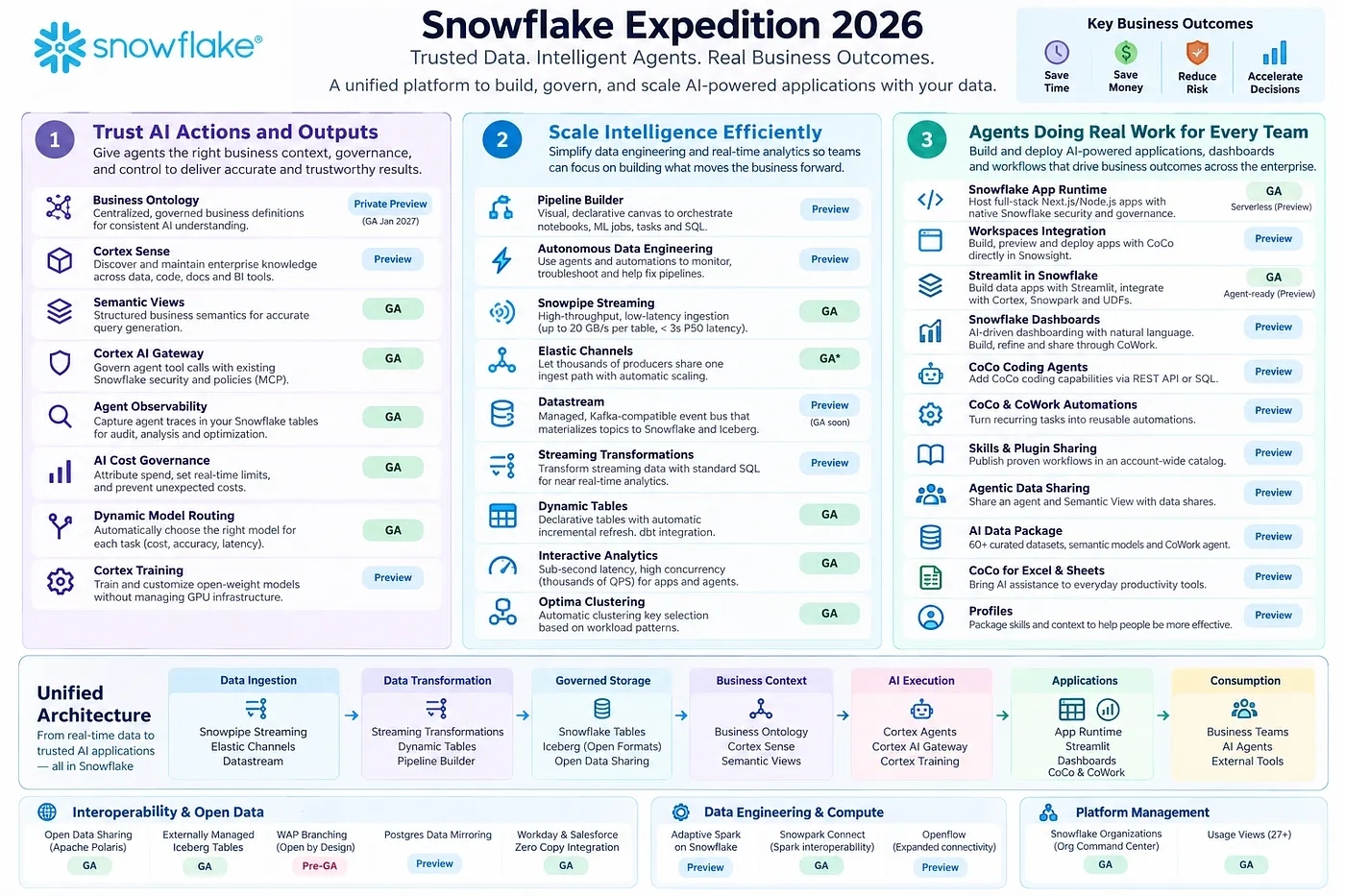
Snowflake’s proposed Business Ontology would store approved, account-level business definitions in Horizon Context. It is intended to work alongside, not replace, Semantic Views. For example, a company could retain different finance and marketing definitions of “customer” and specify when each applies. Cortex Sense is designed to discover existing context across code, metadata, documents, BI tools and usage signals.
For agents that act on data, Cortex AI Gateway adds policy checks for Model Context Protocol (MCP) tool calls against Snowflake’s role-based access controls. Snowflake also describes execution traces stored in governed SQL tables, spending limits and dynamic model routing. Its claim of up to 3× better token efficiency from routing should be treated as a product claim, not a result established for every workload. Cortex Training addresses model adaptation to business tasks; reusable CoCo skills and an AI Data Package containing more than 60 industry datasets were also presented.
Streaming data into interactive queries
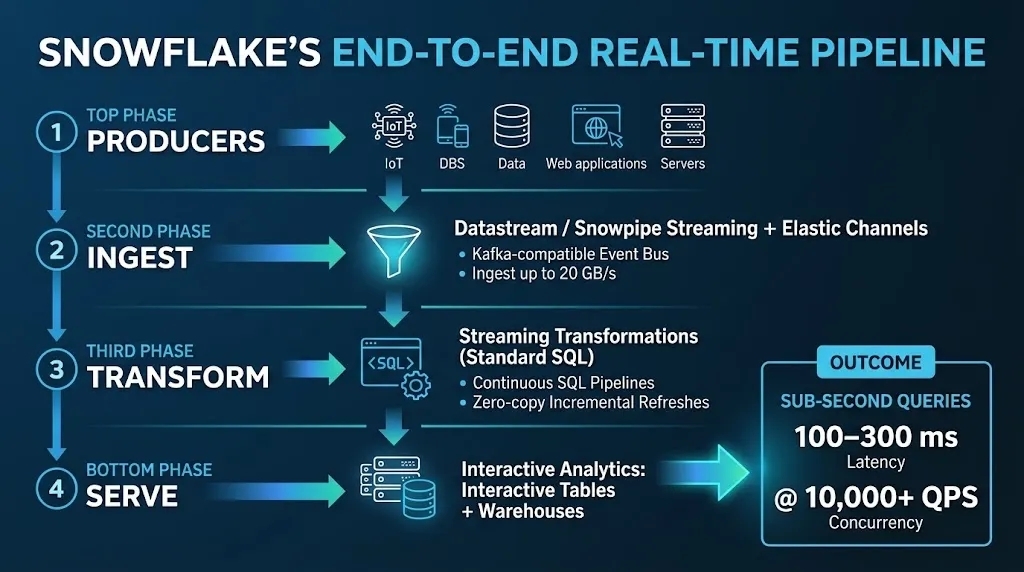
Snowflake describes an architecture intended to keep latency from raw event to interactive query below 15 seconds without an external serving database. Its components include Datastream, a managed Kafka-compatible event bus; Snowpipe Streaming, with a stated ceiling of 20 GB/s per table; and SQL-based streaming transformations. Snowflake says Interactive Tables and Interactive Warehouses can deliver 100–300 ms queries at more than 10,000 queries per second, with up to 40% fewer compute credits than its first-generation hardware. Those figures describe Snowflake’s stated capabilities, not a guarantee for a particular application.
Applications, BI and existing code
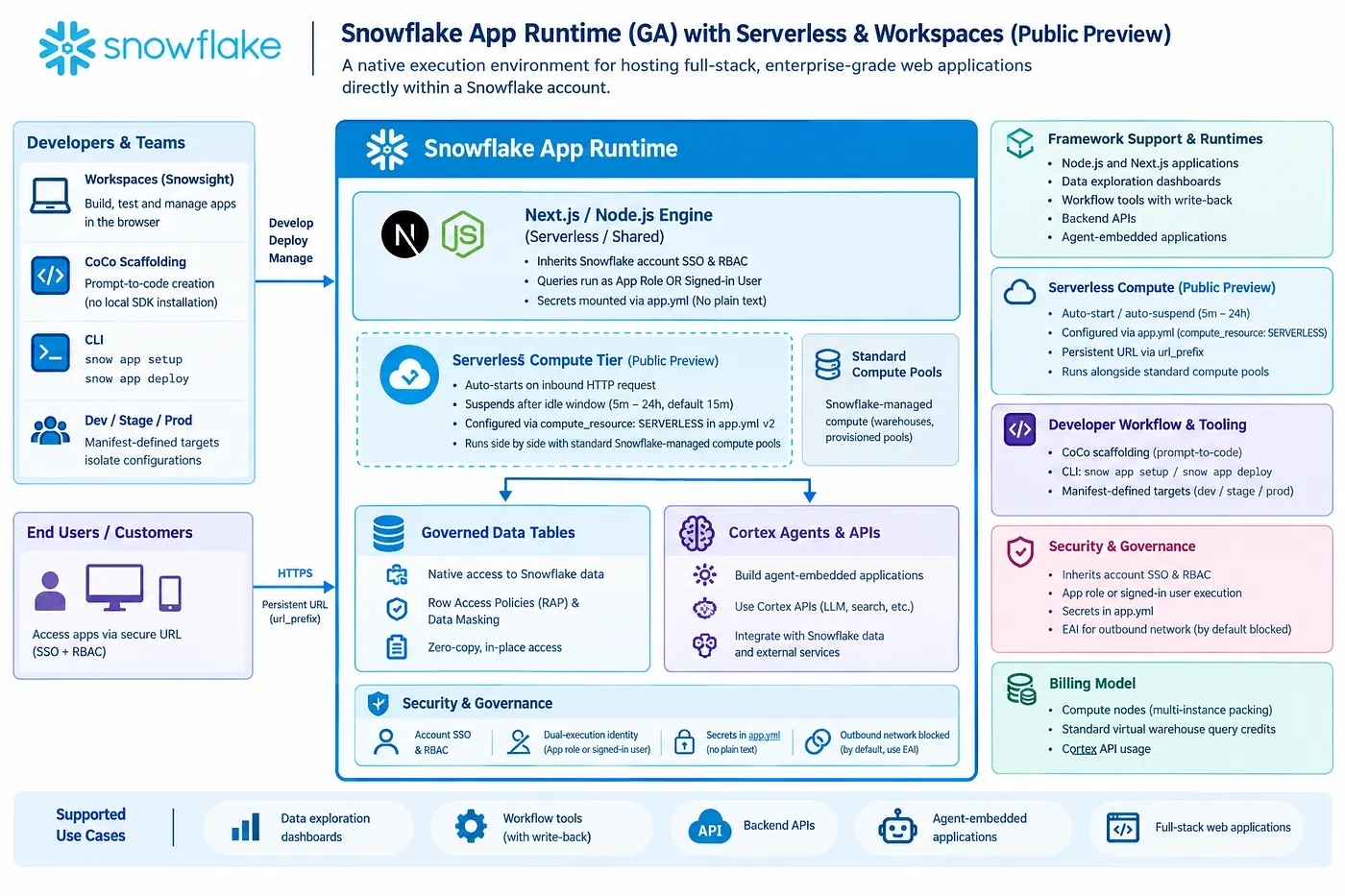
Snowflake Dashboards lets users generate charts through natural-language questions and pin them to dashboards. Snowflake says it runs on warehouse consumption rather than per-user-seat licensing and offers tools to convert existing BI assets. A serverless App Runtime is intended to host Node.js and Next.js applications inside Snowflake, starting on an HTTP request and pausing when idle. Streamlit applications can expose data and actions as MCP tools.
For teams connecting transactional and analytical systems, Postgres Data Mirroring is described as continuously copying Snowflake Postgres tables into the wider Snowflake environment. Syncing data to Postgres was in private preview in the November 2026 report.
Snowpark Connect for Spark supports existing Spark 3.5 DataFrame and SQL API workloads in PySpark, Java and Scala on Snowflake compute. It is not a drop-in path for all Spark code: RDDs, Structured Streaming and some Java/Scala UDFs still require changes. The announcements also cover Iceberg interoperability, generally available zero-copy integrations for Salesforce and Workday, and Iceberg branching for write-audit-publish workflows. Snowflake claims Hybrid Tables can reach up to 8× higher throughput and 4× lower latency without code changes.
Taken together, the announcements outline a more integrated development path. Teams evaluating it would still need to check feature availability, migration effort and performance against their own data and access-control requirements.