
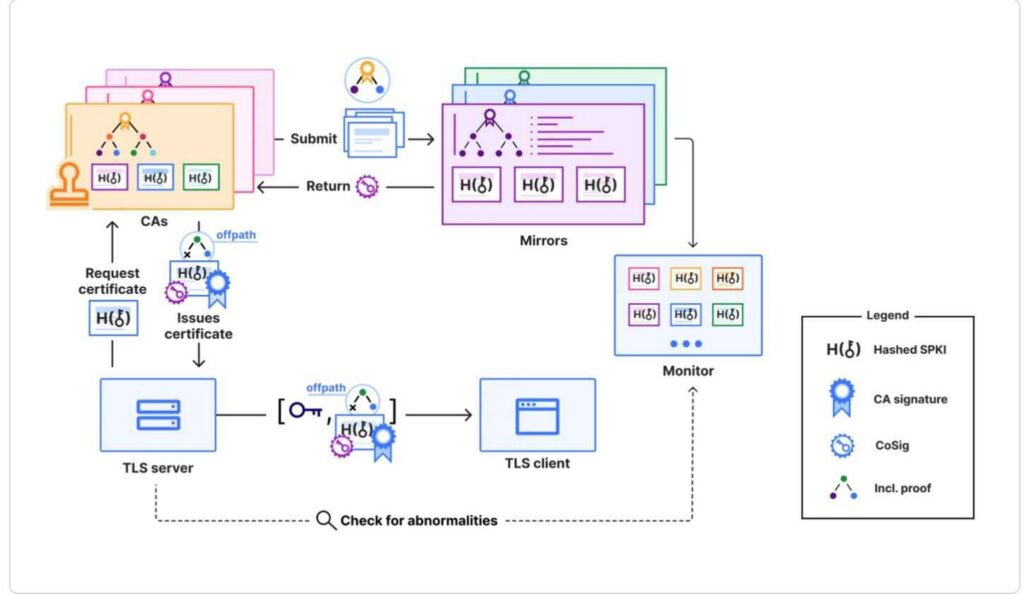
In a report published on November 20, 2026, Cloudflare described an experiment with Merkle Tree Certificates (MTCs) as an alternative to conventional certificate chains. Cloudflare said the Chrome experiment showed a 9% improvement in median performance. It attributed most of the measured gain to eliminating intermediate certificates; the experiment used classical signatures, not post-quantum signatures.
MTCs combine certificate issuance with transparency logging. Rather than signing each certificate individually, a certificate authority records certificate data in an append-only Merkle tree and signs checkpoints. A client can then verify a certificate’s inclusion using a compact cryptographic proof. Cloudflare said post-quantum signatures can be roughly 40 times larger than classical signatures, making certificate size a scaling concern for Web PKI.
In Cloudflare’s design, domain ownership is validated through ACME. Independent mirror co-signers verify and store updated tree states, helping detect inconsistent views of the log and preserve issuance records if the original log becomes unavailable. Cloudflare also distributes authenticated landmarks to clients so they can verify landmark-relative certificates. In the usual case, it said, a TLS handshake carries a public key, a signature and an inclusion proof smaller than 1 KB. The server must still prove possession of its private key.
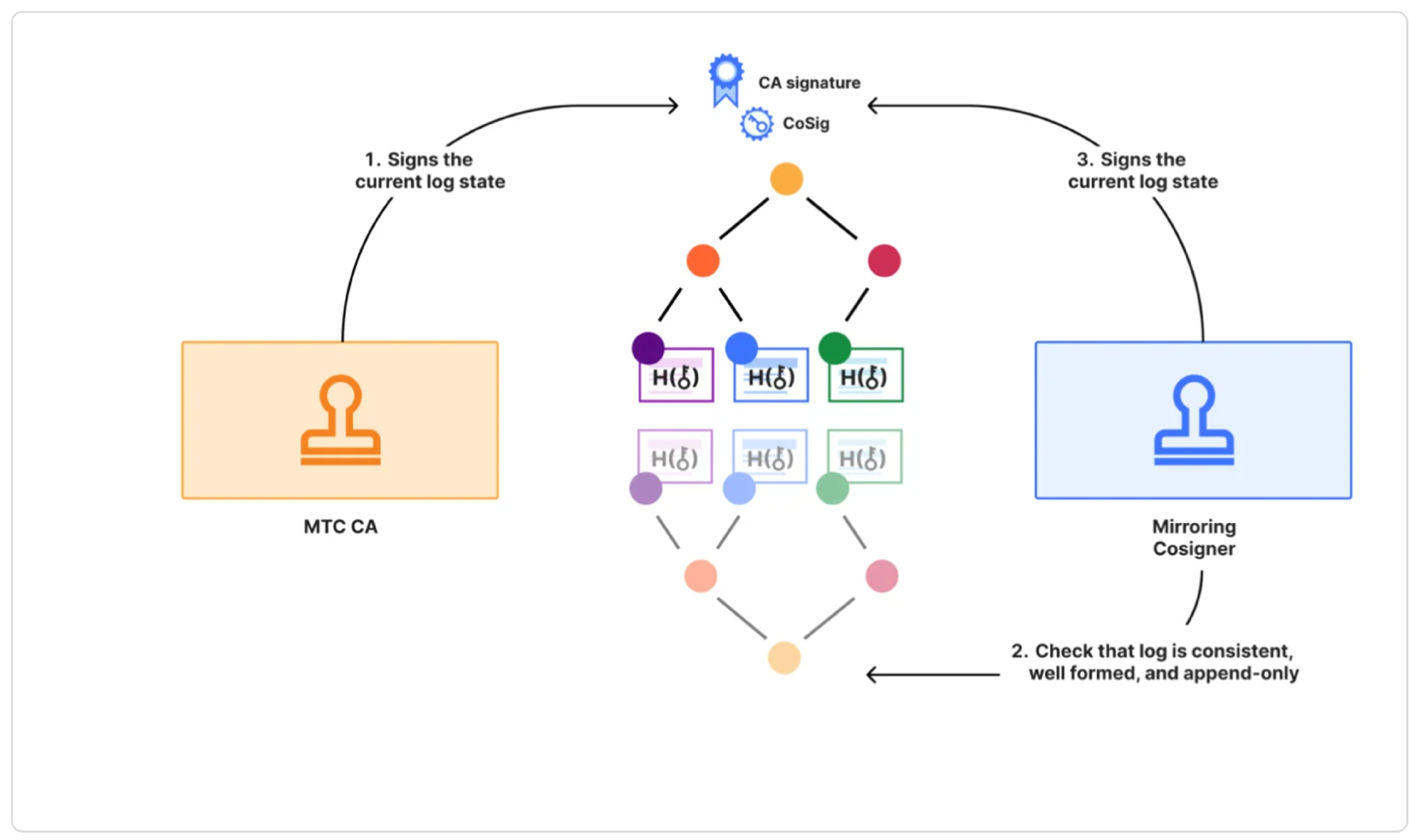
The experiment delivered billions of MTCs for selected domains on Cloudflare’s free plan to 50% of Chrome Beta 146 users. It ended in August 2026. Because a newly installed or offline client might not have the relevant landmark update, servers must retain a standalone MTC certificate as a fallback.
Cloudflare said it was developing a public certificate authority capable of issuing MTCs and planned to seek its inclusion in Chrome’s quantum-resistant root store in early 2027, subject to evaluation. It identified independent production-grade monitoring, a diverse ecosystem of certificate authorities and co-signers, and browser support as remaining requirements for wider deployment. Commenting on Cloudflare’s announcement on LinkedIn, SSL.com support specialist Alicja Tendaj raised a separate question about how quickly an included certificate could be stopped in revocation or incident-response scenarios.