
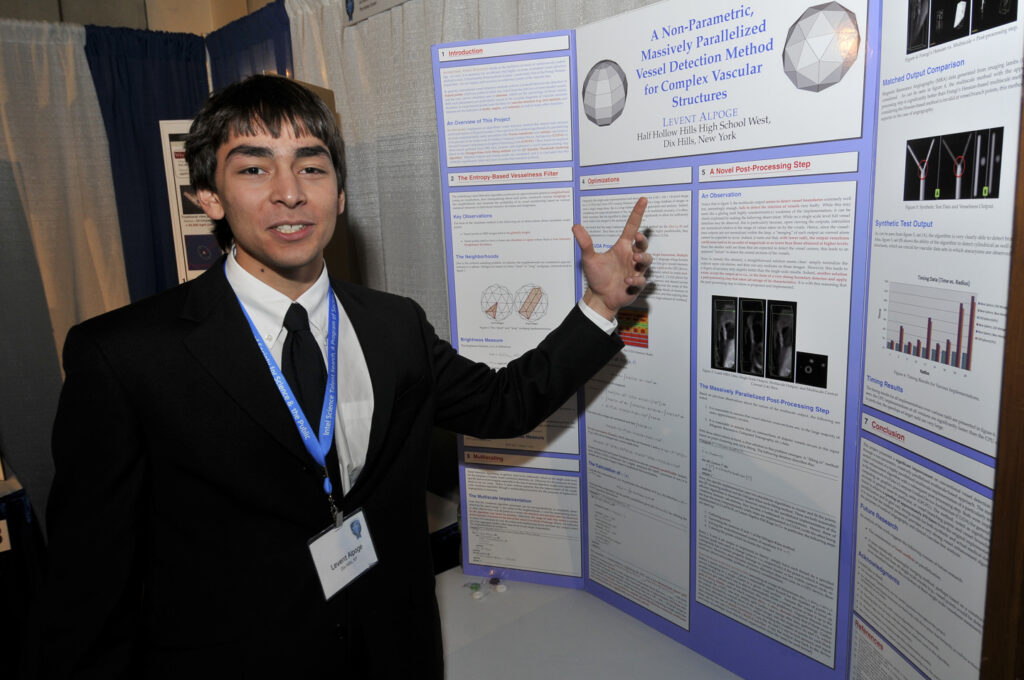
On November 20, 2026, Anthropic researcher Levent Alpöge said he and Claude had found a proof of the Riemann Hypothesis and its generalization, the Generalized Riemann Hypothesis (GRH). The claim had not been independently verified when it was reported on November 21.
Alpöge said he directed Claude toward a key line of research and that the system then produced mathematical ideas that surprised him. According to Alpöge, their written proof exceeds 250,000 pages and has not been released. The public materials consist of a four-page explanation and approximately 17 million lines of Lean code distributed across 14 compressed archives.
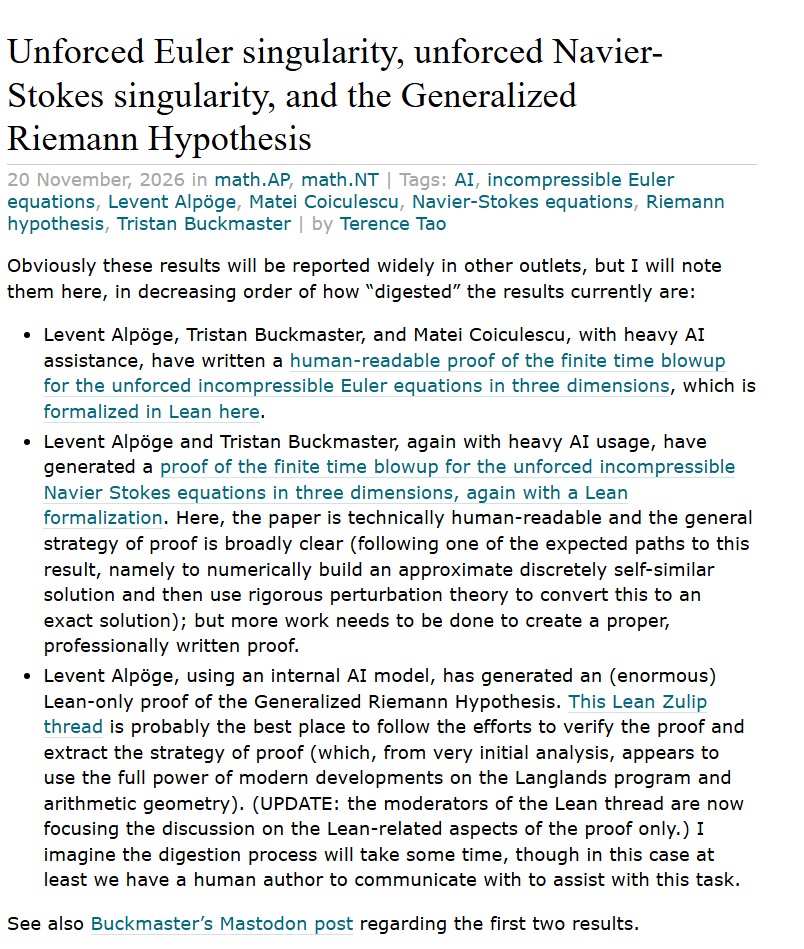
Lean is an interactive theorem prover whose kernel checks formal deductions. That check alone cannot establish that a formal statement captures every intended meaning of the original mathematical conjecture. After an initial inspection, mathematician Elliot Glazer said the proposition formalized in Alpöge’s Lean files is GRH. Glazer also noted the theoretical possibility of a reliability flaw in Lean itself, though he estimated that risk at well below 1%.

Mathematician Terence Tao wrote that, on a very preliminary reading, the proposed proof appeared to draw on modern work in the Langlands program and arithmetic geometry. He said it would take time for mathematicians to identify the central ideas and check whether they are correct. Rutgers University professor Alex Kontorovich expressed greater confidence about its prospects in a post on X, saying a proof of the Riemann Hypothesis would need to “use everything.” Neither reaction amounts to verification.

Even if the code passes Lean’s checks and its formal target is confirmed to match the conjecture, recognition by the Clay Mathematics Institute would be a separate process. Under the institute’s rules, a solution to a Millennium Prize Problem must be published in a peer-reviewed journal, undergo at least two years of scrutiny and gain general acceptance in the mathematical community before it can be considered for a prize. The Riemann Hypothesis is one of the seven problems announced in 2000, with a $1 million prize attached.