
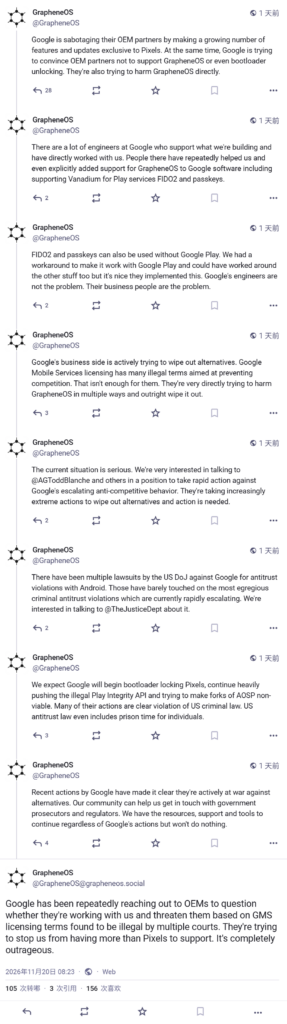
In a report published on November 21, 2026, GrapheneOS accused Google of pressuring Android phone makers not to work with the project or support bootloader unlocking. These are GrapheneOS’s allegations; the report does not establish that Google took those actions.
GrapheneOS said Google had repeatedly contacted device makers to ask whether they were working with the project, then used Google Mobile Services (GMS) licensing terms to apply pressure. The project argued that this could make it harder to expand beyond Pixel phones.
That concern has a practical context. GrapheneOS has primarily supported Pixel phones, but Motorola announced a long-term partnership with the GrapheneOS Foundation at MWC 2026 in March to develop compatible devices. Motorola later confirmed that the Signature 27 would be the first phone with official GrapheneOS support. The reported partnership is distinct from GrapheneOS’s allegation about Google’s conduct.
GrapheneOS also criticized the Play Integrity API. In the project’s view, checks tied to GMS licensing can prevent some apps—including banking apps—from working on hardware or operating systems without the relevant authorization. It said some EU countries were adopting the API in their own apps and that an earlier attempt to discuss the issue with the European Commission had made no progress.
The project distinguished Google’s business decisions from its engineers’ work. It said some Google engineers had helped add support for GrapheneOS’s Vanadium browser to FIDO2 and passkey features in Google Play services.
The November report also noted that an EU court upheld a €4.1 billion fine in July 2026 in an Android antitrust case involving restrictions on phone makers. GrapheneOS said it wanted to contact the US Department of Justice because, in its view, earlier antitrust penalties had not changed Google’s behavior. It further predicted that Google might restrict bootloader unlocking on Pixel phones, but described that as a future possibility, not an announced change.