

Originally reported by FreeBuf on November 9, 2026.
A FreeBuf article describes a four-day observation of a self-developed semantic web application firewall (WAF) protecting a publicly accessible cross-border business site. The article’s central finding is a practical boundary: normalizing and parsing a payload can help detect attacks disguised by encoding or inserted comments, but it may miss an attack that only becomes meaningful after the application combines separate parameters.

How the reported setup worked
The WAF ran behind a reverse proxy on a public server with two CPU cores and 2 GB of memory. According to the article, its processing chain used 14 layers of encoding normalization, abstract syntax tree (AST) parsing, and arbitration across 12 independent evidence paths. It did not receive rule updates or cloud threat intelligence during the observation period.
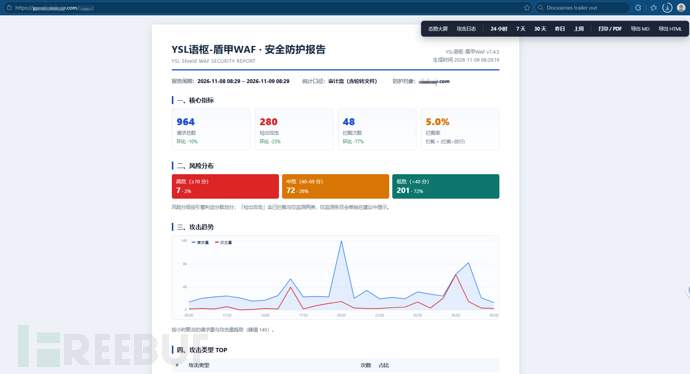
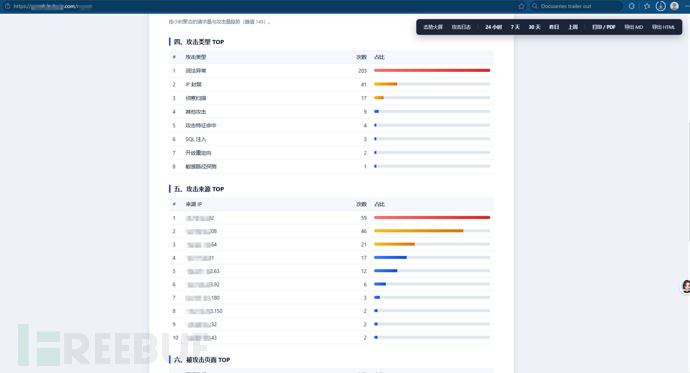
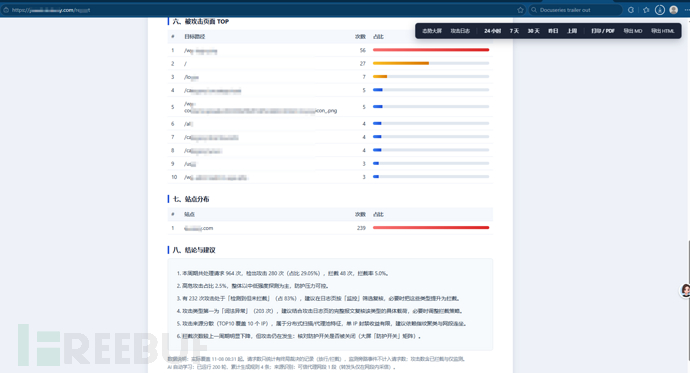
The authors say their main observations came from live visitor and probing traffic, not a batch of generated test payloads. They also replayed missed public-traffic samples in a local test environment using the same engine version and configuration to investigate why detection failed.
What the authors observed
The article reports strong detection of most observed automated SQL-injection probes that used nested URL encoding or comments to split keywords. It describes detection of common reflected-XSS encoding variants as stable, while noting misses involving less common tag variants. Most observed command-execution probes using whitespace or split keywords were reportedly blocked, and normal buyer requests produced few false positives. The article provides qualitative assessments, not detection rates or request counts, so these observations should not be read as a measured benchmark against other WAFs.
The clearest misses involved malicious logic split across multiple request parameters. Each parameter lacked an independently malicious syntax; the attack expression emerged only after the backend combined them. The authors say those misses reproduced locally, pointing to a limitation of analyzing parameters separately at the gateway rather than a transient failure.

The implementation boundary
Normalization and AST parsing address changes to a payload’s appearance while its attack syntax remains intact. They cannot, on their own, determine how an application will concatenate inputs. The article also identifies unsupported syntax and database dialects, private encryption or custom encodings, authorization and business-logic flaws, and transport-layer or high-volume traffic attacks as outside this engine’s coverage.
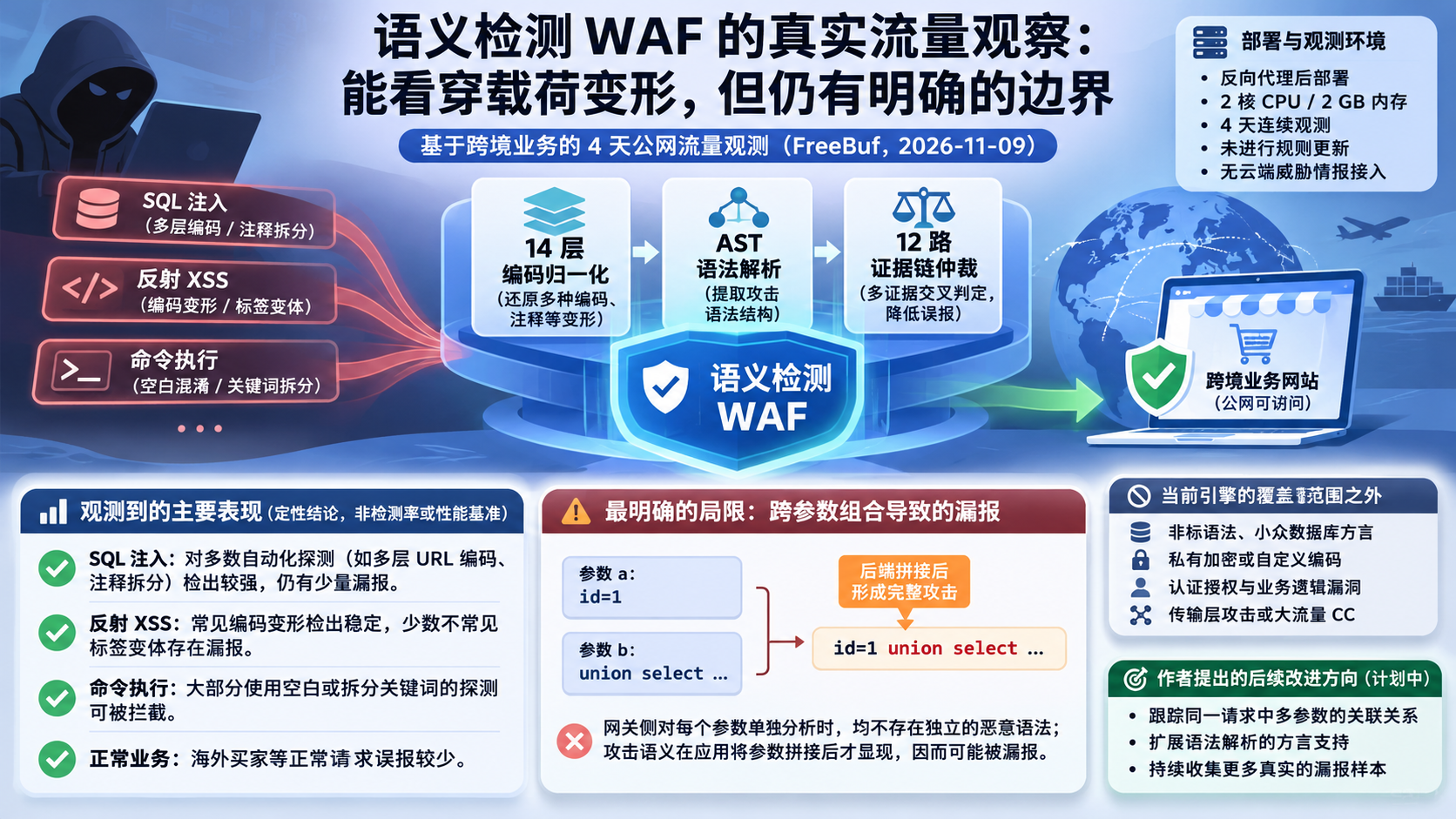
The authors propose tracking relationships among parameters in the same request, expanding parser dialect support, and collecting more real-world missed samples. These are planned improvements, not capabilities demonstrated in the four-day observation. The report concerns the authors’ authorized business traffic and local test environment; its results do not establish how the engine would perform on other applications.