
Originally reported by InfoQ on November 10, 2026.
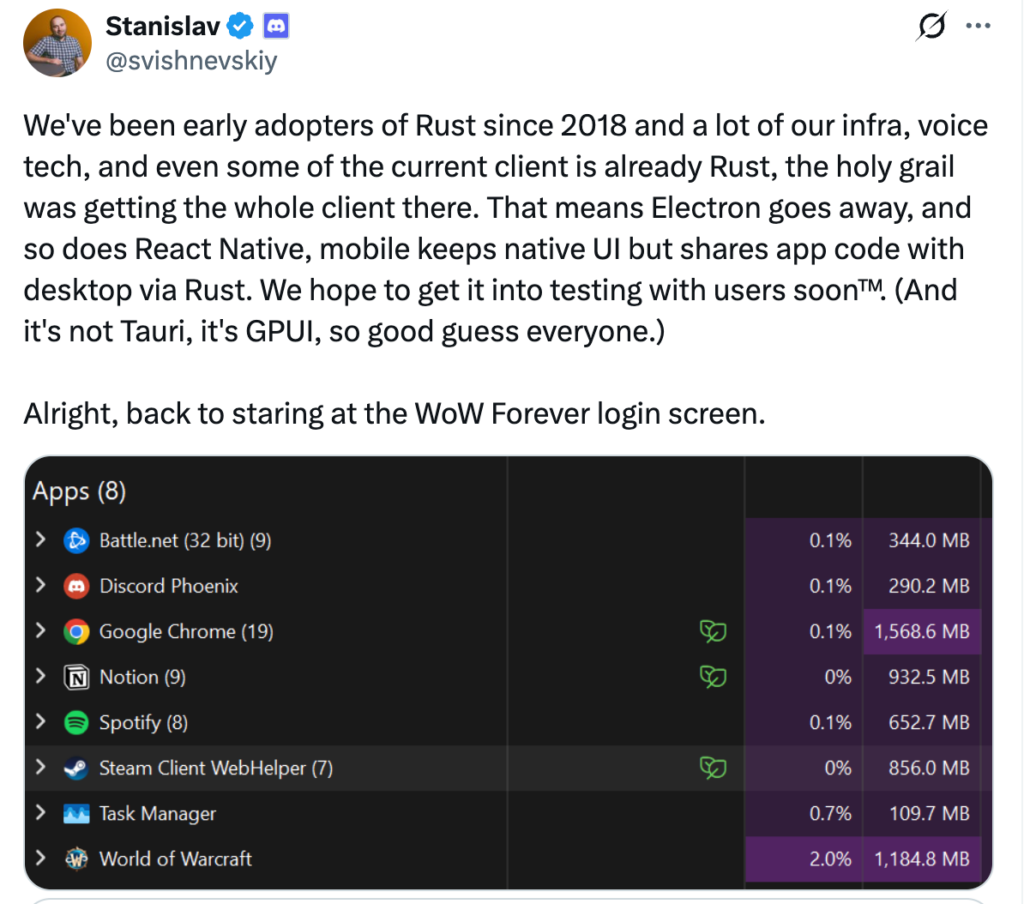
Discord is moving its client code toward Rust. Co-founder and CTO Stanislav Vishnevskiy said the desktop app will drop Electron, while the mobile apps will move away from React Native. The company has not announced a release date and says it hopes to open testing to users soon.
A Windows Task Manager screenshot shared by Vishnevskiy showed a new client called “Discord Phoenix” using about 290.2 MB of memory while running two accounts. That is a demonstration, not a measured reduction across typical workloads. Vishnevskiy also described the new client as faster and more responsive, but independent performance results were not provided in the report.
Different interfaces, shared Rust code
For desktop, Discord chose GPUI, a Rust-based, GPU-rendered interface framework developed by the Zed editor team, rather than Tauri’s usual approach of rendering a web interface in a system WebView. Vishnevskiy said the app should retain largely the same appearance and features; specific features, including YouTube and Activities, will still use a system WebView. A Discord developer said the team has modified GPUI extensively and hopes to contribute some changes upstream.
On iOS and Android, Discord plans to keep platform-native interfaces and share core application code through Rust instead of simply bringing the desktop interface to phones. For the web client, Vishnevskiy said Discord will have an HTML renderer, with application logic using WebAssembly rather than JavaScript.
The rebuild follows years of performance work. Discord reported that a September 8, 2026 desktop update to Electron 42 reduced median CPU use by about 17% while increasing median memory use by about 4%. Its React Native mobile updates reduced average CPU use and startup time by about 5% each. Earlier, Discord investigated Windows clients exceeding 4 GB of memory and tested a tightly limited automatic-restart measure that it described as temporary.
Rust is not new to Discord: Vishnevskiy said the company began adopting it in 2018 and already uses it in infrastructure, voice technology and parts of the client. Still, a Rust rewrite does not by itself guarantee lower resource use. The new desktop stack must also handle platform integration, accessibility and ongoing framework maintenance. Users have raised a separate concern that existing third-party themes and modifications built around the web-based client may stop working; a Discord developer said the rebuild’s focus is performance, not restricting modifications.
Source: infoq.cn (originally published 2026-11-10 16:04 UTC+8)