
In a report published on November 23, 2026, Vals AI said OpenAI’s GPT-6.2 Astra produced a machine-verifiable Lean proof of Smoktunowicz’s gap theorem without human help during the run. Vals described it as the first known Lean proof of the 2006 theorem.
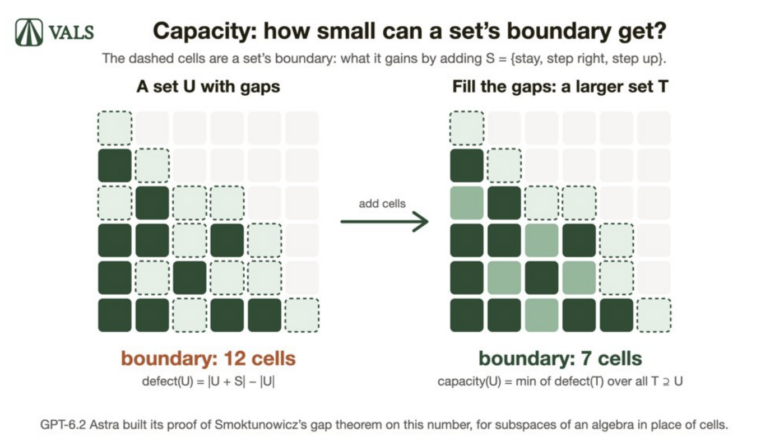
The theorem concerns how a mathematical system grows when its basic building blocks are multiplied: growth must be either relatively slow or very fast, with no middle ground. According to Vals, foundations used in published proofs were missing from the Mathlib library, so Astra took a different approach. It built the proof around capacity, a measure drawn from existing research that tracks the minimum number of elements added per computation step.
The attempt took place on Autoform-Hard, a 56-task subset of Meta FAIR’s AutoformBench curated by Vals; five of its tasks had been corrected. Ten models in Meta’s study had failed to solve those tasks within budget. Astra tried to stop after 47 minutes and $8, but the system did not accept an unsolved submission before $20 had been spent. After nine minutes without code input while it searched for another strategy, Astra submitted an approximately 1,800-line proof at the 94-minute mark, at a cost of $21.58.
Vals reported that Astra then led the benchmark leaderboard with 49 solved tasks, compared with 48 each for GPT-6.2 Sol and Claude Fable 5.2. That result concerns this benchmark; it does not establish that no other AI could prove the theorem under different conditions.